
Based on 2022 NTCA tiger status report of India, tigers were photo-captured for the first time in Buxa Tiger Reserve, Neora Valley National Park, and Mahananda Wildlife Sanctuary in West Bengal. Also, after quite a few years, a tiger was photo-captured in the Namdapha Tiger Reserve of Arunachal Pradesh. The report also mentions that Tiger reserves and protected areas in Arunachal Pradesh are connected through large, forested tracts and a number of reserve forests situated along the interstate border between Arunachal Pradesh and Assam.
This landscape is further connected to Intanki National Park in Nagaland and Dampa Tiger Reserves in Mizoram through some weak linkages of degraded forest. Several indigenous forest communities dependent on bush meat and forest resources for subsistence inhabit this landscape; hence, the prey base is almost depleted in many of the forests. In addition, due to its strategic location, several highways are planned in Arunachal Pradesh to provide faster access to international border areas.

Arunachal Pradesh gets three national highways: the Frontier Highway, the Trans-Arunachal Highway, and the East-West Industrial Corridor Highway, and six vertical and diagonal interstate highways of about 2178 km will be built. Fragmentation of habitat by this rapid infrastructure development will eventually destroy the weak linkages between the tiger habitats and might lead to the local extinction of tigers in this landscape. Substantial poaching for the illegal trade of tiger body parts and ungulates constantly threatens the tiger population in this landscape. Since the landscape shares porous international borders in many parts with neighbouring Southeast Asian countries, it is comparatively easy for poachers to operate in this landscape. In the recent past, the skin and body parts of two tigers were seized from Dibang Valley in Arunachal Pradesh and Itakhola on the Assam-Arunachal Pradesh border. Direct exploitation of tigers from this already low abundant population, coupled with habitat fragmentation and biotic pressure, could eventually deplete the tiger population in this landscape. Other than rapid development causing habitat fragmentation and the poaching of wild tigers and prey, the invasion of weeds in the natural habitat is a severe threat to this landscape.
The institute responsible for tiger conservation in India itself recognizes these facts behind depleting tiger population in the Dibang-Kamlang-Namdapha block of tiger landscape in Arunachal Pradesh. The state has three tiger reserves namely Pakke, Kamlang, Namdapha tiger reserve and Dibang Wildlife Sanctuary. As per 2022 tiger status survey, only nine tigers were photo-captured in this state.
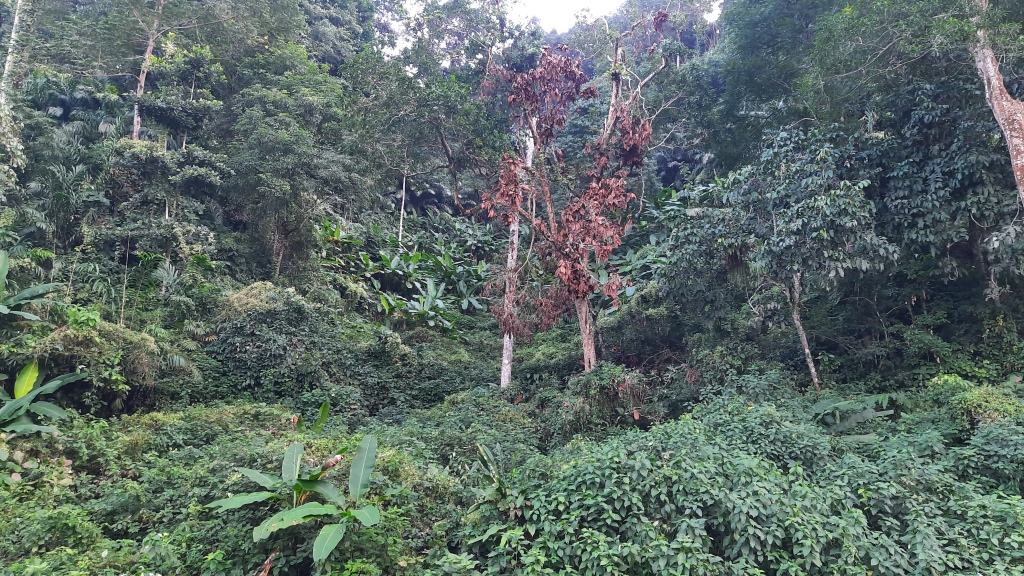
However, the status of Arunachal’s tiger population does not tell the real story of its phenomenal biodiversity resources. This state is an ecological wonder that remains largely unexplored. The tropical rain forest of the Namdapha National Park, one of India’s largest protected area, throbs with a dizzying array of flora and fauna, many of which are lesser known, hidden gems of the wild.

After completing our exploration in Dehing, on following day, on 14th December, at around 6:00 AM we started for Namdapha National Park and Tiger reserve, the main destination of our exploration. On the way we stopped at various village forests, ponds and water streams for bird watching. Some noteworthy sightings were – greater necklace laughingthrush and red headed trogon near exit gate of Dehing; Oriental pied hornbill feeding on banana and coconut tree in a village; pied falconet perching on a tree top and occasionally snooping for butterflies, just before the entry gate of Namdapha; and few black capped and white crowned forktails near a water stream within Namdapha. We reached at Devan Forest camp of Namdapha at around 4:00 PM. In this part of India, sun goes down by 4:00 PM and by 4:30 PM light was quite low. In the evening between 6:00 PM and 8:30 PM we did a nigh-walk within the tiger reserve to search for slow loris. We stayed in Devan camp for three nights and every night we searched for that nocturnal animal. But never succeed. Instead, every night we saw red giant flying squirrel feeding on tree bark within our campus.

On 15th December at morning 6 o’clock we did a moderate hiking in the Haldi Bari area of the tiger reserve. From our forest camp it was three hours hike, which included crossing Nua Dehing river through a precariously constructed bamboo hanging bridge, climbing steep hillock, and walking through dense foliage. From the hoolock gibbon, the only ape species found in India, to the elusive snow Leopard and the majestic red panda, Namdapha is a living testament to the intricacies and wonders of evolution. The day was sunny, and the forest was resounded with iconic call of hoolock gibbons. This reserve is unique, not just for its lofty stature as the third largest of its kind in India but also due to the strikingly varied altitudinal range of its landscape. Ranging from 200 metres to an astounding 4,500 metres, it provides the tiger and numerous other species with an environment of unparalleled diversity.

Before we returned to our camp at 12:00 noon, quite a few rare birds we spotted and shot. Some of them were slaty bellied tesia, white tailed flycatcher, streaked wren-babbler, white throated bulbul, rufus backed sibia, long-tailed broadbill, Durian redstart, and eye-browed wren-babbler. Afternoon again we explored the road goes through buffer zone of Namdapha towards Vijaya Nagar, where India ends, and Myanmar starts. Oriental hobby, rufous-gorgeted flycatcher, dark breasted rose finch, little forktail were some notable sightings. Our day ended with much delight by sighting of Oriental Bay owl, which we were trying to spot from day one.

Next day was all about full day walk on the road passing through tiger reserve towards India-Myanmar international border. We left our camp at 6:00 AM and returned at 5:00 PM. Between Deban camp and Kamala Valley camp we spotted and identified birds like white-bellied erpornis, snowy throated wren babbler, brown crowned scimitar babbler, greater rufous headed parrot bill, white hooded babbler, hill prinia, black throated sunbird, white-rumped munia, Nepal fulvetta, pale-billed parrot bill, white browed piculet, whistling warbler, grey headed canary flycatcher, black chinned yuhina, long-tailed sibia, and mountain imperial pigeon.

As per Forest Department’s norm, one local forest guide named Assam Mussang was also with us for two days in Namdapha. He told us that tourists are allowed only in selected routes in buffer zone of this tiger reserve. Rest of the forest is not even suitable for walking. Leave aside the possibility of driving car or jeep. Therefore, ecotourism activity does not happen in most of the buffer and entire core zone of Namdapha. Only forest department staffs and researchers go there for study and installing camera traps. Even forest patrolling is limited in majority part of this forest due to difficult accessibility. That is why probably NTCA was also sounded helpless in their 2022 tiger status report while explaining depleting tiger and its prey base population in Arunachal Pradesh. Assam Mussang told us that Kodwai zone is part of buffer and core, where maximum number of tiger pugmarks and camera trap images were recorded. His comment was well resonated with NTCA’s 2022 status report of recording one tiger in Namdapha.

The day was sunny and the snow-capped Dapha bum, the highest point of Namdapha was visible from our exploration track. Despite of depleting tiger population, Namdapha stood tall with array of its magnificent biodiversity. As one steps into an era marked by climate change and biodiversity loss, Namdapha shines as a beacon of hope, a sanctuary where life thrives in its countless forms. It stands as a testament to the resilience of nature when given the chance to flourish and the power of people when they become stewards of the land. At the end of the day when we came back to our camp, the resident red giant flying squirrel was found to be feeding on tree bark. That was how my last night in India’s last tiger reserve ended with a message, “to become a splendid ecotourism destination, raining of tiger sighting is not essential. The forest has much more to offer than the tigers.”

We left Namdapha on 17th December, towards Miao, the border town between Arunachal and Assam. Our next destination on Maguri bill which was in news because of one of the recent environmental disasters of India.
 Pseudo Ecotourism