
Other effective area-based conservation measures‘ (OECMs) are areas that are achieving the long term and effective in-situ conservation of biodiversity outside of protected areas.
In my opinion nature related activities cannot be considered as mere supplementary pursuits, based on ecotourism in a few glorified destinations, visited by most ecotourists and photographers. I have explored and witnessed the ecotourism and photography potential in various natural areas in northeast hills of India, that are located outside protected areas but are home to endangered and ecologically important species. Thus, the next dimension of inclusive ecotourism, the I reckon, is exploring and understanding these ‘other’ areas.
I have been part of ecotourism based on OECM in the northeast hills and Gangetic plane tiger habitats comprising Buxa, Manas, Orang and Kaziranga.
Buxa Tiger Reserve is a tiger reserve and national park in northern West Bengal, India, covering an area of 760 km2 (290 sq mi). It ranges in elevation from 60 m (200 ft) in the Gangetic Plains to 1,750 m (5,740 ft) bordering the Himalayas in the north. At least 284 bird species inhabit the reserve. Mammals present include Asian elephant, gaur, Sambar deer, clouded leopard, Indian leopard, and Asian golden cat. The Bengal tiger is also present but rarely seen; as of 2005, Buxa Tiger Reserve had only one resident tiger.

Manas National Park is a national park, Project Tiger reserve, and an elephant reserve in Assam, India. Located in the Himalayan foothills, it borders the Royal Manas National Park in Bhutan. The park is known for its rare and endangered endemic wildlife such as the Assam roofed turtle, hispid hare, golden langur, and pygmy hog. It also hosts the only known population of pygmy hogs in the world. Manas is also famous for its population of the wild water buffalo. Because of its exceptional biodiversity, scenery, and variety of habitats, Manas National Park is a biosphere reserve and a UNESCO World Heritage Site.
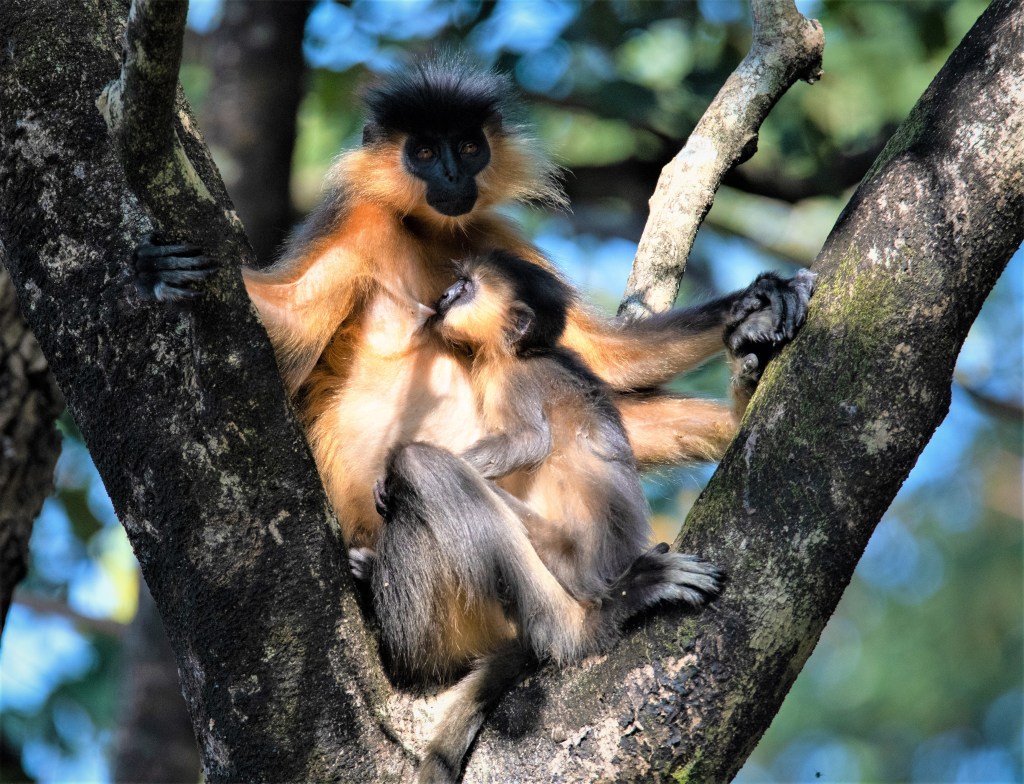
Orang National Park is a national park in India located on the northern bank of the Brahmaputra River in the Darrang and Sonitpur districts of Assam. It covers an area of 79.28 km2 (30.61 sq mi). It was established as a sanctuary in 1985 and declared a national park on 13 April 1999. It is rich in flora and fauna, including great Indian rhinoceros, pygmy hog, Asian elephant, wild water buffalo and the Bengal tiger. It is the only stronghold of the rhinoceros on the north bank of the Brahmaputra.

Kaziranga National Park is a national park in the Golaghat, Sonitpur, Biswanath and Nagaon districts of the state of Assam, India. KNP has 5 ranges. The park, which hosts two-thirds of the world’s Indian rhinoceroses, is a UNESCO World Heritage Site. According to a March 2018 census conducted jointly by the Forest Department of the Government of Assam and some recognized wildlife NGOs, the rhino population in Kaziranga National Park is 2,613. It comprises 1,641 adult rhinos and 385 calves.
In 2015, the rhino population stood at 2,401. Kaziranga National Park was declared a Tiger Reserve in 2006. The park is home to large breeding populations of elephants, wild water buffalo, and swamp deer. Kaziranga is recognized as an Important Bird Area by BirdLife International for conservation of avifaunal species which refers as the birds or types of birds found in a specific region, period, or environment. When compared with other protected areas in India, Kaziranga has achieved notable success in wildlife conservation. Located on the edge of the Eastern Himalaya biodiversity hotspot, the park combines high species diversity and visibility.
Kaziranga is a vast expanse of tall elephant grass, marshland, and dense tropical moist broadleaf forests, criss-crossed by four major rivers, including the Brahmaputra, and the park includes numerous small bodies of water. Kaziranga has been the theme of several books, songs, and documentaries. The park celebrated its centennial in 2005 after its establishment in 1905 as a reserve forest.

To know, how the ecotourism based on OECM contributes to inclusive ecotourism read Pseudo Ecotourism in the Shadow of the Bengal Tiger.
 Pseudo Ecotourism