When urban affluent folks start considering their hobby as the most unique one!

Stricken by the desire for being the most interesting person in the room, after a successful first trip in Gir, we decide to further strengthen this new hobby of wildlife photography, by creating opportunities to live in proximity to nature. Hardships in the tropical rainforest of Periyar tiger reserve made us realize our limitations in living close to nature. However, driven by a hunger for fame and glory, all we desire is to take pictures of the Bengal Tiger in the wild to distinguish ourselves as unique.

Rafting through Periyar River

We named this exploration as “Hiking in Highlands” as Western Ghats can very well be considered as highlands of Indian subcontinent, because of floral and faunal diversity, rain clad mountains, and evergreen forests. The exploration had five segments – Rangnathettu bird sanctuary, Nagarhole National Parks, Bandipur National Park, Eravikulam National Park and Periyar National Park.

Rout map of “Hiking in Highland”

Ranganathittu Bird Sanctuary (also known as Pakshi Kashi of Karnataka), is a bird sanctuary in the Mandya District of Karnataka in India. It is the largest bird sanctuary in the state, 40 acres (16 ha) in area, and comprises six islets on the banks of the Kaveri river. The sanctuary has been designated on 15 February 2022 as a protected Ramsar site since 2022. Ranganathittu is located 3 km (1.9 mi) from the historic town of Srirangapattana and 16 km (9.9 mi) north of Mysore. The sanctuary attracted about 3 lakh visitors during 2016–17.

A spot-billed pelican at Ranganathettu

Nagarahole National Park is a national park located in Kodagu district and Mysore district in Karnataka, India. This park was declared the 37th Tiger Reserve of India in 1999. It is part of the Nilgiri Biosphere Reserve. The Western Ghats Nilgiri Sub-Cluster of 6,000 km2 (2,300 sq mi), including all of Nagarhole National Park, is under consideration by the UNESCO World Heritage Committee for selection as a World Heritage Site. The park has rich forest cover, small streams, hills, valleys and waterfalls, and populations of Bengal tigergaurIndian elephantIndian leopardchital and Sambar deer.

Spotted deer at Nagarhole
Herd of elephants in Nagarhole

Bandipur National Park is a national park covering 868.63 km2 (335.38 sq mi) in Chamarajnagar district in the Indian state of Karnataka. It was established as a tiger reserve under Project Tiger in 1973. It is part of the Nilgiri Biosphere Reserve since 1986. The Maharaja of the Kingdom of Mysore created a sanctuary of 90 km2 (35 sq mi) in 1931 and named it the Venugopala Wildlife Park. The Bandipur Tiger Reserve was established under Project Tiger in 1973 by adding nearly 800 km2 (310 sq mi) to the Venugopala Wildlife park.

Leopard on tree at Bandipur

Eravikulam National Park is a 97 km2 national park located along the Western Ghats in the Idukki and Ernakulam districts of Kerala in India. The park is situated between 10º05’N and 10º20′ north, and 77º0′ and 77º10′ east and is the first national park in Kerala. It was established in 1978. Eravikulam National Park is administered by the Kerala Department of Forests and Wildlife, Munnar Wildlife Division, which also runs the nearby Mathikettan Shola National ParkAnamudi Shola National ParkPambadum Shola National ParkChinnar Wildlife Sanctuary and the Kurinjimala Sanctuary.

Nilgiri Tahr at Eravikulam

Periyar National Park and Wildlife Sanctuary (PNP) is a protected area located in the districts of Idukki and Pathanamthitta in KeralaIndia. It is an elephant and a tiger reserve. The protected area encompasses 925 km2 (357 sq mi), of which 305 km2 (118 sq mi) of the main zone was declared as the Periyar National Park in 1982. The park is a repository of rare, endemic, and endangered flora and fauna and forms the major watershed of two important rivers of Kerala: the Periyar and the Pamba. The park is located high in the Cardamom Hills and Pandalam Hills of the south Western Ghats along the border with Tamil Nadu. It is 4 km (2.5 mi) from Kumily, approximately 100 km (62 mi) east of Kottayam, 110 km (68 mi) west of Madurai and 120 km (75 mi) southeast of Kochi.

Source of Information: Wikipedia

Hiking in Highlands – through dense forest of Periyar

In real sense the quest for Bengal Tiger was started by my friend and me, at 6:30 in the morning of 2nd December 2015 from the Bandipur National Park. Although Bandipur National Park was our first dedicated venture in the shadow of Bengal Tiger, but technically the exploration in tiger habitat started from another national park of Western Ghats – the Nagarhole National Park. The Kabini side of the park is famous for sighting of melanistic leopard – commonly known as Black Panther. However, we did not go to Kabini. In the morning of 30th November 2015, both of us with our driver cum “Man Friday” Purushottam, reached at the Veeranahosahalli range of Nagrahole National Park from our base camp at Jungle Inn resort. Before coming to Nagarhole, en route, we visited Ranganathettu, the largest bird sanctuary of Karnataka, situated on the bank of Cauvery River.

After finishing our exploration in Bandipur, on same day afternoon, we came back to Bangalore and took an overnight bus to reach Munnar on next day morning. After spending next whole day, exploring Eravikulam National Park, we reached forest rest house at Thekkady in the evening of 4th December. On 5th December at 9:00 am we reached at the check post of Periyar Tiger Reserve to start one of the most adventurous and challenging forest hiking of this country, the Periyar Tiger Trail, with a hope that our bad luck for sighting tiger would end there.

To know what happened in that exploration, in the Highlands of Indian subcontinent, and how my life started changing after that trip, read my recently published book.

The book is now available through seventeen global distributors:

Read the review of books in GoodReads:

https://www.goodreads.com/book/show/212106582-pseudo-ecotourism

You can read free sample Chapters at :

In the Shadow of the Bengal Tiger: How it was started….

To cope with rejection in personal life, I find various ways to become the most interesting guy in the room. Later, when I meet one of my childhood friends, Vedavyasa, who is on his own quest for fame and glory, I was introduced to ecotourism and wildlife photography through my fist ever wildlife safari in the arid forest of Gir. In my new-found hobby, the underlying cause for human obsession with fame and glory does not go unnoticed. This underlying cause is created by the materialism of today’s world as a new commodity for fame hungry people.

Mane Lodge at Gir

Gir National Park and Wildlife Sanctuary, also known as Sasan Gir, is a forest, national park, and wildlife sanctuary near Talala Gir in Gujarat, India. It is located 43 km (27 mi) north-east of Somnath, 65 km (40 mi) south-east of Junagadh and 60 km (37 mi) south-west of Amreli. It was established in 1965 in the erstwhile Nawab of Junagarh‘s private hunting area, with a total area of 1,410.30 km2 (544.52 sq mi), of which 258.71 km2 (99.89 sq mi) is fully protected as a national park and 1,151.59 km2 (444.63 sq mi) as wildlife sanctuary. It is part of the Khathiar-Gir dry deciduous forests ecoregion.

The 14th Asiatic Lion Census 2015 was conducted in May 2015. In 2015, the population was 523 (27% up compared to previous census in 2010). The population was 411 in 2010 and 359 in 2005. The lion population in Junagadh District was 268 individuals, 44 in Gir Somnath District, 174 in Amreli District, and 37 in Bhavangar District. There are 109 males, 201 females and 213 cubs.

The population of Asiatic lions has steadily grown in Gir forest, and the broader Saurashtra protected area. The lion population escalated from 523 to 674 individuals between the years 2015 and 2020.

Gir National Park is closed from 16 June to 15 October every year, throughout the monsoon season.

Source: Wikipedia

Pugmark of an Asiatic Lion
First sighting of Asiatic Lion (female) at Gir
Male India pea fowl at Gir

The exploration to spot Asiatic Lion started at 6:00 am of 25th May 2015 through route number 6 of Gir National Park.  Forest guide Abu bhai and driver Mehbub accompanied my friend and me. Immediately after entering the forest, fresh pugmarks were observed. As usual we started following the footprints – movement of male and female with cubs were quite prominent among other pugmarks. The trail was suggesting a small pride was probably shifting from one location to another. Strong smell of carcass was also felt, but no vultures or other scavengers were found anywhere around. After two hours of tracking and covering around 20-25 Km distance, finally two sub-adult males were spotted from around 60-meter distance under shades of trees at the crossing point of safari route number 5 and 6 of the park. They were found lying under the shades of trees. Few forest guards were found to be gathered there. This is typical scenario in Gir. Wherever lions are sighted there would be few forest guards sitting leisurely at a safe distance with stick in their hands. Photographers take images of those lions, and there would be a suggestive body language of ownership displayed by those guards, as if their pets were being photographed. “Cohabitation” indeed. These guards informed us that, early in the morning both the lions hunted together and after eating they had started moving to find a cool place to take rest for the whole day.

To know what happened in my very first wildlife photography trip in Gir National Park and how my life started changing after that trip, read my recently published book.

Its available in paperback, hardcopy and eBook at:

https://www.ukiyotoindia.com/product-page/pseudo-ecotourism

For International readers at:

https://www.ukiyoto.com/product-page/pseudo-ecotourism

It’s also available in Amazon:

Hardbound, Dust Jacket, Kindle and Paperback

The unexplored ecological wonder of North-East Hill landscape: Maguri Beel

Maguri Motapung Beel is a wetland and lake located near Dibru-Saikhowa National Park and Motapung Village of Tinsukhia district in Assam. Maguri Motapung Beel serves as a natural home to wildlife and provide a source of livelihood to the local communities.

On May 27, 2020, a fountain of crude oil polluted the waters of the wetland, and it caught fire on June 9. Conditions have recovered since then, and one highlight for the Maguri Beel wetland post the disaster has been the sighting of a Mandarin Duck in the lake for the first time in 118 years.

Maguri beel in dense fog of winter morning

On 17th December, at around 5:00 PM we reached at Maguri beel. Our nature guide Palash has his own resort there. He also lives in a nearby village. After reaching there Palash took us to couple of nearby tea estates to search for brown hawk owl, oriental and collared scops owl. Eventually in the village itself we found hawk owl and in the front yard of Palash’s house we found quite a few collard-scops owl perching on trees.

Collard scops Owl

Next day as early as 5:30 in morning after a short boat ride we reached at the other side of the Maguri beel to explore the grassland which is also part of Dibru-Saikhowa National Park. There we spotted hen harrier, endangered swamp grass babbler, golden cisticola and straited babbler. Then at around 7:00 AM we went to another side of the grassland across the water body near the Baghjan village. The village is also known as the victim of one of the recent environmental disasters. A blowout, explosion, and fire lasting more than five months, from 27th May to 15th November 2020 the natural gas well of Oil India Limited (OIL) at Baghjan in Assam’s Tinsukia district has resulted in the loss of an estimated 55 % of the biodiversity in the affected Dibru-Saikhowa landscape. As many as 1,632 hectares of wetland, 523 ha of grassland, 172 ha of area covering rivers and streams, and 213 ha of forest were damaged to varying degrees.

Swamp grass babbler

During our exploration in the grassland of Baghjan, we spotted the vulnerable and elusive marsh babbler. Besides that, we also spotted dusky babbler, chestnut capped babbler and puffed chested babbler among other regular birds.

Marsh babbler

In this whole trip of Dehing, Namdapha and Maguri Beel-Dibru-Saikhowa, I saw around 100 different birds and 80% of them were spotted for the first time ever in my life. That was why it was one of my memorable biodiversity and photography trips in India. Forests of Arunachal, indeed, have much more to offer than tigers and elephants. However, the Forest Department of this country was always sounded hopeless about the forests of Arunachal Pradesh for not sighting of tigers and elephants.

Swampland between Maguri beel and Dibru-Saikhowa

Based on an article written by Rupak Goswami in 1st August 2023 edition of EastMojo, “At Namdapha Tiger Reserve (NTR) in Arunachal Pradesh, none of the Range Officers stays inside the NTR area, and the responsibility of on-the-ground protection is largely delegated to the contingency staff, who are about 150 in number, out of which 50 are part of the tiger protection force. This sensitive landscape of 1985km2 with unique biodiversity, is managed by three ranges with a very meagre staff. The infrastructure for protection, like roads, patrolling paths, anti-poaching camps and motorcycles is very poor. The tiger reserve is hit hard by encroachment issues due to the increasing populations of the Lisus and other tribes. The Lisus are expanding their areas under cultivation and cardamom has a ready market as a cash crop. As of now, it is reported that there are eight Lisu villages with 311 families occupying the critical tiger habitat.”

As per this article, the presence of elephants of late has not been reported from within NTR. We know only one tiger was reported in 2022 NTCA tiger status report. The Management Effectiveness Evaluation Report (MEE) of the Namdapha Tiger Reserve said, “it is apprehended that probably the elephant population has adversely been impacted by hunting by tribes which might have found a ready market in the neighbouring countries”.

A section of Maguri Beel sand bed

Although I said before that, forests of Arunachal have much more to offer than tigers and elephants, but one cannot deny that to protect this exquisite biodiversity, tigers and elephants are required too. Otherwise, human greed will eventually perish the biodiversity abundance of the “Land of the Rising Sun”.


The unexplored ecological wonder of North-East Hill landscape – Dehing Patkai

North-East landscape of India comprises the states of Arunachal Pradesh, Assam, Manipur, Mizoram, Nagaland, Sikkim, Tripura, and hilly districts of northern West Bengal. This landscape can be further classified as North Bengal Dooars, Brahmaputra flood plains, and North-East hill region. It is situated alongside international borders with Nepal, Bhutan, People’s Republic of China (China occupied Tibet), Myanmar, and Bangladesh, and connected to peninsular India through a narrow strategic stretch, Siliguri Corridor. As the landscape shares 90% of its boundary with neighbouring countries, it is one of the most important geo-strategic locations of the country. This landscape also is home to more than 200 ethnic and indigenous communities. Other than the cultural plurality, North-East and Brahmaputra flood plains landscape is diverse with natural resources.

Since the landscape shares porous international borders in many parts with neighbouring Southeast Asian countries, it is comparatively easy for poachers to operate in this landscape. In the recent past, the skin and body parts of two tigers were seized from Dibang Valley in Arunachal Pradesh and Itakhola on the Assam-Arunachal Pradesh border. Direct exploitation of tigers from this already low abundant population, coupled with habitat fragmentation and biotic pressure, could eventually deplete the tiger population in this landscape. Other than rapid development causing habitat fragmentation and the poaching of wild tigers and prey, the invasion of weeds in the natural habitat is a severe threat to this landscape.

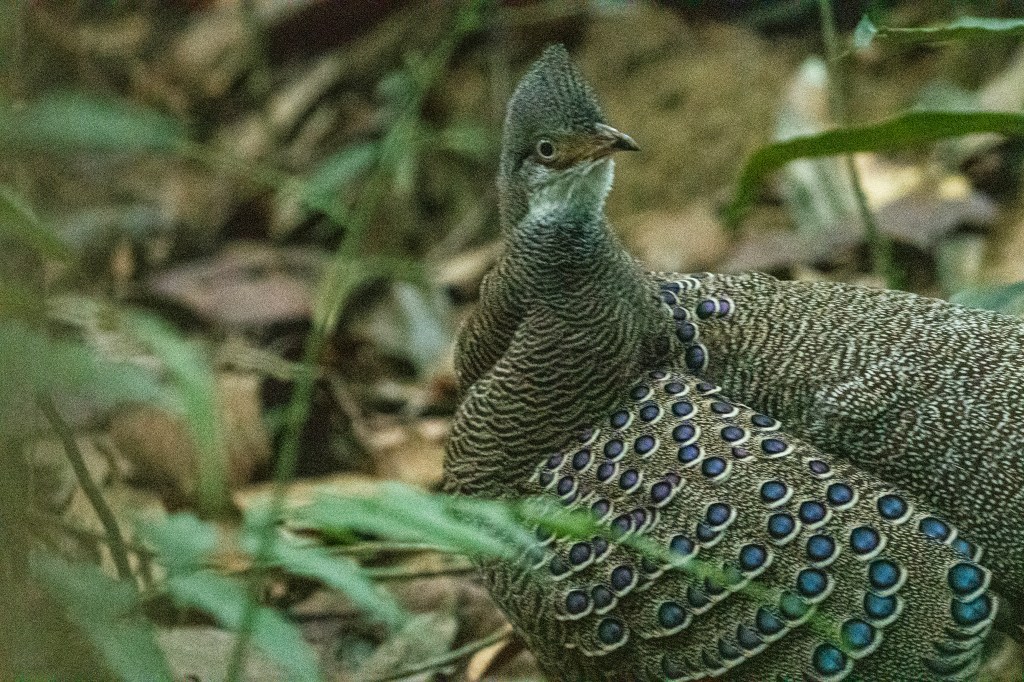
Grey peacock pheasant at Dehing Patkai

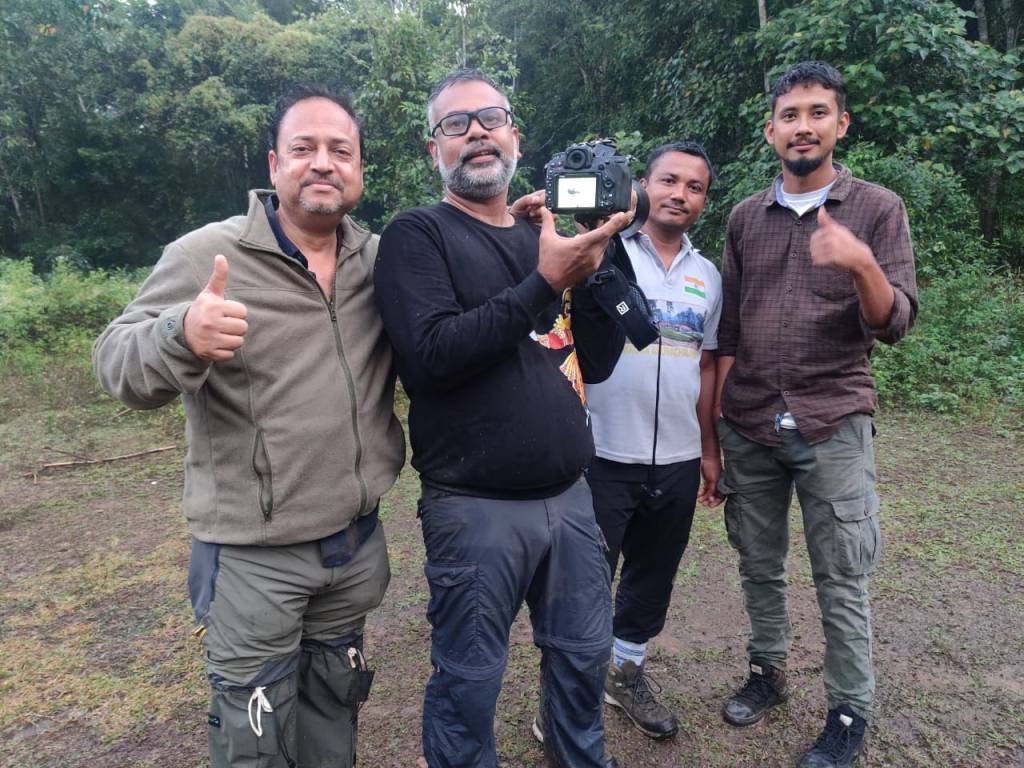
Between 12th and 18th November of 2023, I did intense biodiversity exploration in around 400 km stretch consisting of Diban camp of Namdapha and its surrounding areas including Haldibari, Highiand and Kamala Valley camp, Dheing Patkai National Park and Maguri beel as well as adjacent grasslands of Dibru Saikhowa National Park. Around 2:30 PM, we started our journey from Dibrugarh airport and reached at our homestay in Digboi at 6:00 PM. I was with a reputed bird watching guide of North-East, named Palash Phukan. I was also joined by another experienced bird photographer from Pune, named Suyog Ghodke.

Dehing Patkai exploration team

As per schedule, after reaching close to our homestay in Digboi, we went to look for Oriental Bay owl in the forest of Dehing. Dehing Patkai National Park harbours the largest stretch of lowland rainforests in India. The rainforest stretches for more than 575 km2 in the districts of Dibrugarh, Tinsukia and Charaideo. The forest further spreads over in the Tirap and Changlang districts of Arunachal Pradesh. The Wildlife Sanctuary was also declared as Dehing Patkai Elephant Reserve under Project Elephant. After reaching at a particular patch of dense forest, which was apparently not allowed to be explored on foot, Palsh started playing call of bay owl. Within few seconds the bird started responding to that call from a nearby tree. However, before spotting the bird, Palsh’s torch light caressed through an elephant like object. In the darkness it was not possible to distinguish that object clearly from the large tree trunks in background. Nevertheless, an elephant head like curvature was vaguely noticed in torchlight.

That unclear vision mixed with fear and imagination was enough to make all of us run for our dear life and get inside the car parked around 100-200 meters away from the forest patch. Elephant is the main reason why exploring Dehing’s forest in foot in darkness is not allowed.

Ashy headed green pigeon at Dehing

Next day, we started at 6:00 AM and continued till lunch break at 1:30 PM. It was all bush walking, ascending, and descending through dense foliage of Dehing Patkai rainforest. Within an hour of our morning exploration, we got to see a male grey peacock pheasant. When we were busy in shooting that bird from quite proximity, our driver Guru sent an SOS of elephant alert through walkie-talkie to Palash. He saw a male elephant standing behind our car which was parked on the forest path and upon noticing Guru it entered deep forest, where we were busy with peacock-pheasant. Therefore, another run for the life for us and that was bit difficult and far scarier than the previous one. That time the sighting of elephant was real and forest path was more hostile because of thorny bush, thick foliage, and muddy path.

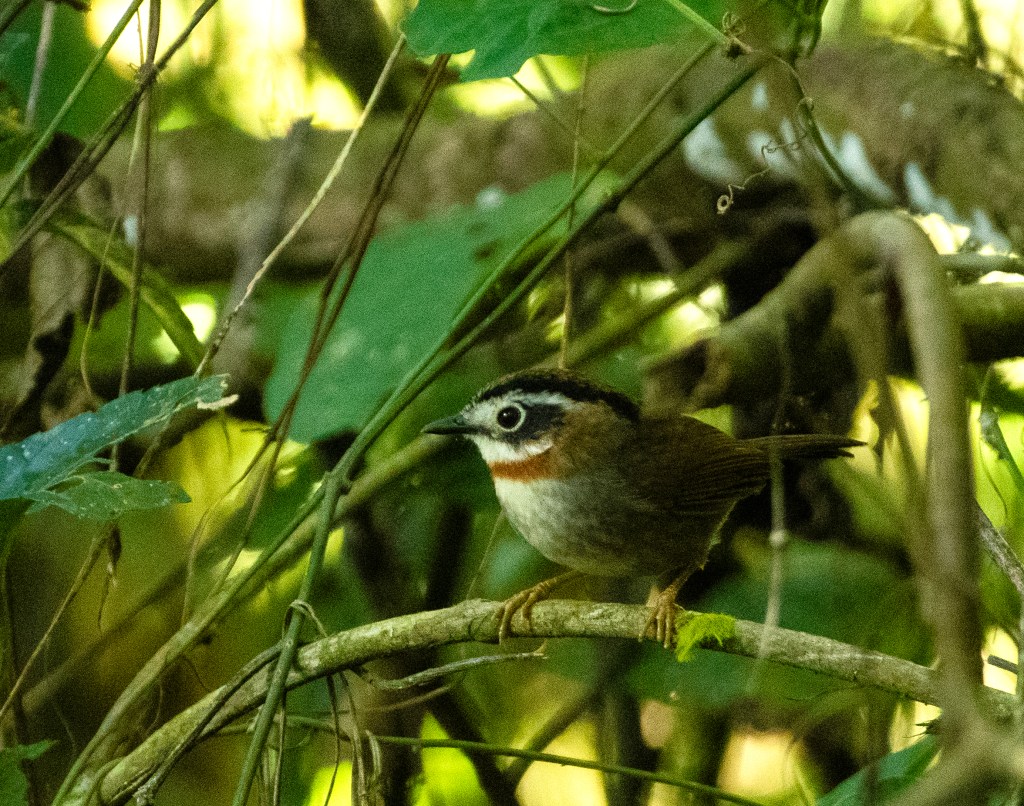
Rufus throated fulvetta at Dehing

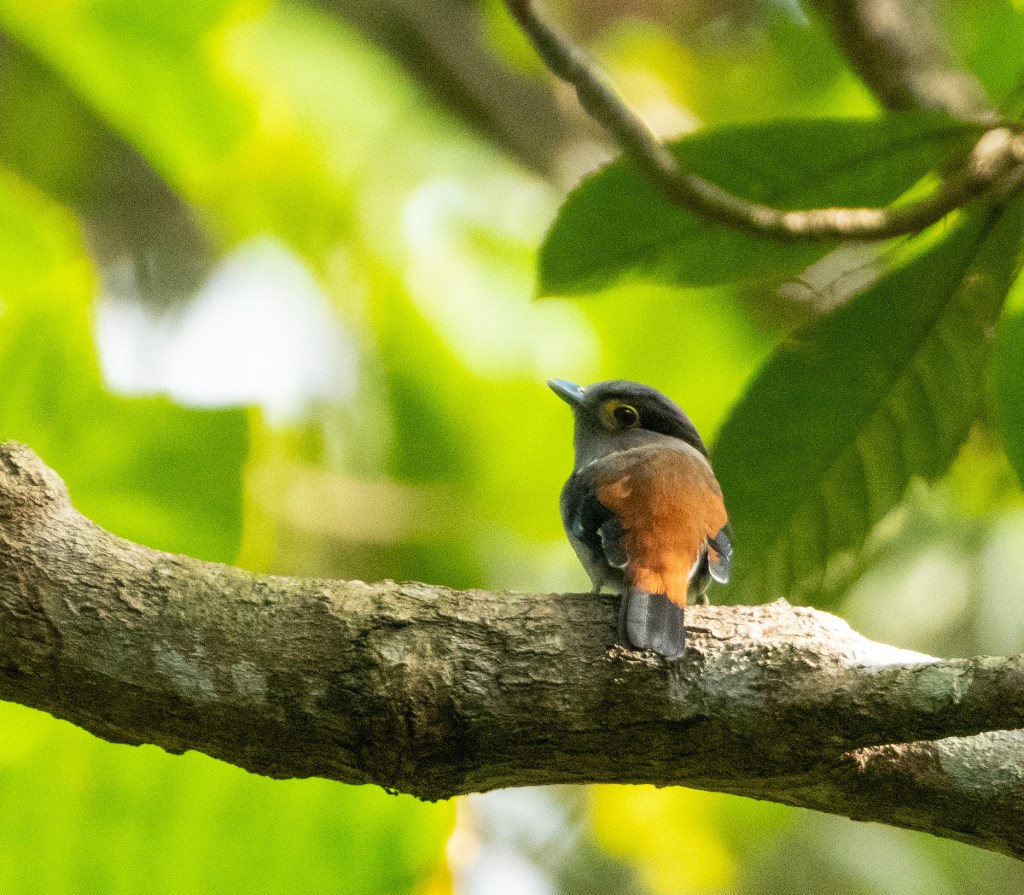
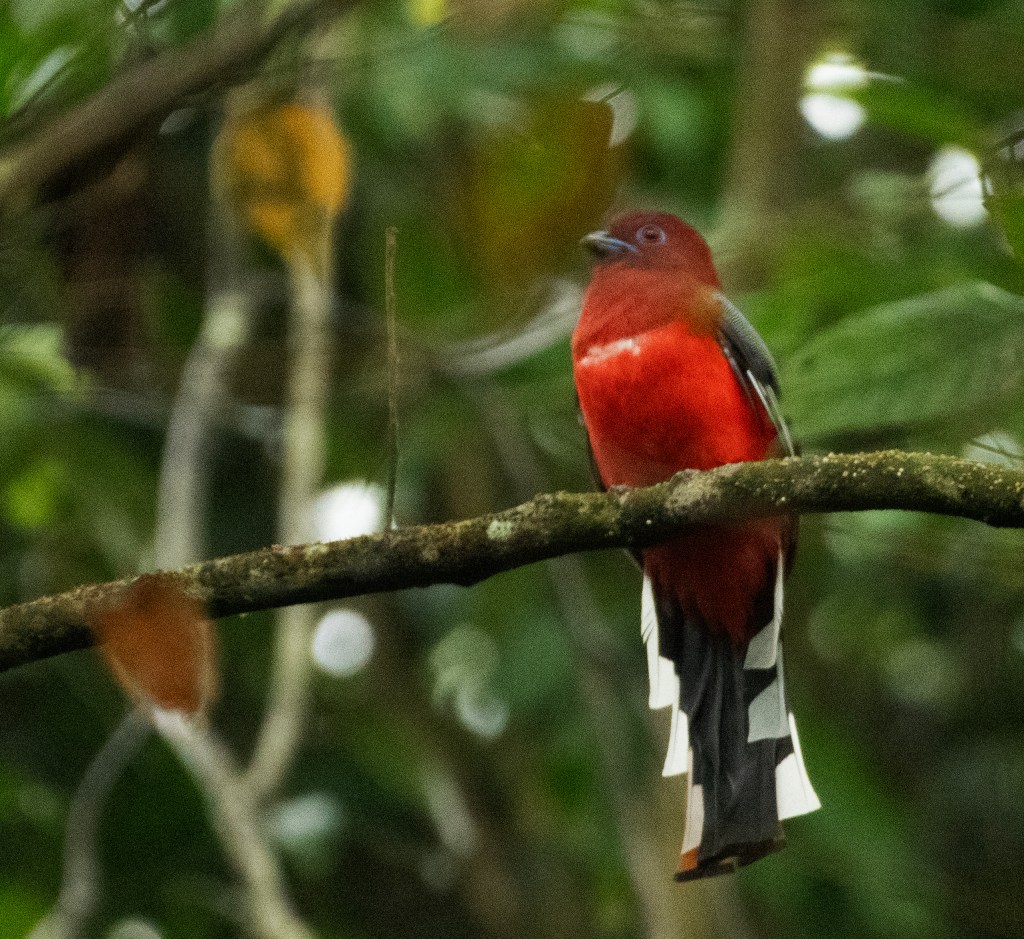
Somehow, we came out of dense forest and reached where our car was parked. It was time for breakfast after few hours of intense bird-walk. Rest of the morning we did easy to moderate hike in the forest and spotted various birds which were first in life sighting for me, such as grey peacock-pheasant, pale capped pigeon, rufus throated fulvetta, chestnut backed laughing thrush, silver breasted broadbill, ashy headed green pigeon, blue-winged leaf bird, red headed trogon, and white spectacled warbler.

Grey-lored broadbill at Dehing

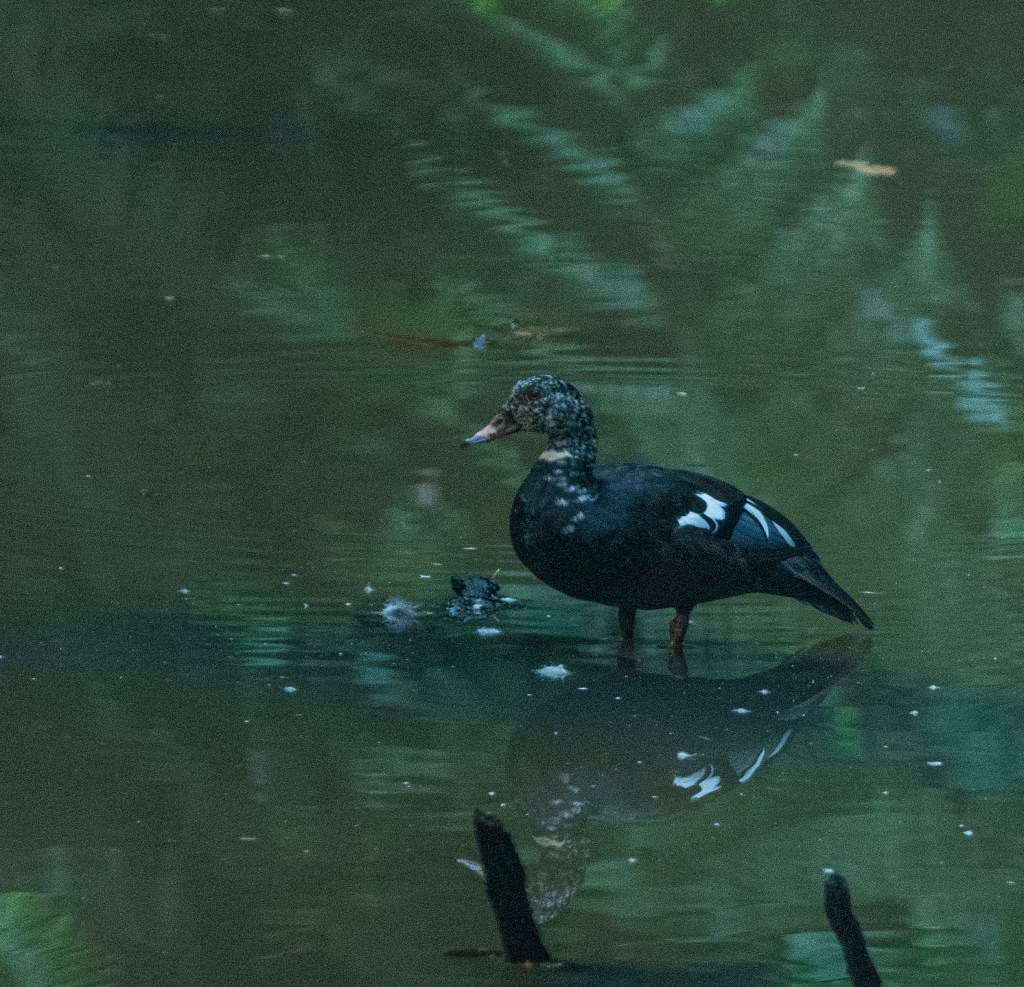
The most exciting exploration in Dehing happened on that afternoon. After a sudden heavy shower, the forest path was muddy and slippery. Therefore, ascending and descending on steep slope became quite difficult. After couple of hours’ physical effort, surviving fear of fall risks, and few actual falls on forest path we reached near a pond and were delighted by a sighting which we would like to cherish for ever. It was a male white-winged wood duck, the state bird of Assam. Decaled as Endangered by IUCN, historically, the white-winged duck was widely distributed from North-Eastern India and Bangladesh, throughout South-East Asia to Java and Sumatra. It is now extinct in Java. In India, the duck is found only in the North-Eastern part of the country, with the main concentration in Eastern Assam and adjacent areas of Arunachal Pradesh. However, in 2002 it had a population of only 800, with about 200 in Laos, Thailand, Vietnam, and Cambodia, 150 on Sumatra, notably in Way Kambas National Park and 450 in India, Bangladesh, and Myanmar. Due to ongoing habitat loss, a small population size, and because this duck is hunted for food, eggs and pets, the white-winged duck is evaluated as Endangered on the IUCN Red List of Threatened Species. In India, the key protected areas for the white-winged duck are Dibru-Saikhowa National Park, Dehing-Patkai Wildlife Sanctuary, Nameri National Park and Namdapha National Park. The white-winged duck occurs in dense tropical evergreen forests, near rivers and swamps.

The elusive white winged wood duck at Dehing – state bird of Assam

Dehing-Patkai as a potential wildlife sanctuary was identified in late 1980s during a primate survey as “Upper Dehing Wildlife Sanctuary”. Subsequently during a study on white-winged wood duck in early 1990s, it was discovered as a globally important site for this duck and recommended to be upgraded to “Upper Dehing National Park”.

After white-winged wood duck sighting for nearly two hours we again went for bay owl when it was dark. But fear of elephant in mind did not let Palash and us to focus on that bird. Therefore, we called it a day and returned to our homestay.

A male red headed trogon at the exit gate of Dehing Patkai National Park

Our next destination was Namdapha Tiger Reserve of Arunachal Pradesh!

“The wise use of wetlands”

Mangalajodi Bird Sanctuary , part of Chilika Lake, A Ramsar site at India’s East Coast

To respond to various social, economic and environmental crises, today’s humankind seek compassion and loving-kindness through ecotourism. The most successful form of ecosystem services ecotourism, is wetland tourism. 2nd February each year is World Wetlands Day. It marks the date of the adoption of the Convention on Wetlands on 2nd February 1971, in the Iranian city of Ramsar on the shores of the Caspian Sea. World Wetlands Day was first celebrated in 1997. Since then, government agencies, non-governmental organizations and groups of citizens at all levels of the community have taken advantage of the opportunity to undertake actions aimed at raising public awareness of wetland values and benefits in general and the Ramsar Convention in particular. More than a decade ago in 2012, the World Wetlands Day theme was Wetlands and Tourism and was linked to the theme for the next meeting of the Conference of the Parties, COP11: Wetlands, Tourism and Recreation, which took place in June 2012, in Bucharest, Romania. In COP11, the benefits of wetland tourism both locally and nationally for people and wildlife were recognized – such as stronger economies, sustainable livelihoods, healthy people and thriving ecosystems. As per the World Wetland Day Reports 2012 from the contracting parties, “at least 35% of Ramsar Sites around the world record some level of tourism activity and this percentage is consistent throughout all regions. Of course, it is important to consider tourism in all wetlands – not just those designated as Ramsar Sites – since the Contracting Parties to the Convention are committed to managing all wetlands. Tourism is only one of the services that wetlands deliver. Ensuring well-managed tourism practices in and around wetlands and educating tourists on the value of wetlands contributes to the health of the world’s wetlands and the long-term benefits that wetlands provide to people, wildlife, economics, and biodiversity.”

Ecotourists row through this creeks in Mangalajodi for bird watching

The largest wintering ground for migratory birds on the Indian sub-continent, home to several threatened species of plants and animals is one such great example of wetland tourism. Chilika Lake is the largest brackish water lagoon in Asia and second largest coastal lagoon in the world, spread over the Puri, Khordha and Ganjam districts of Odisha state on the east coast of India, at the mouth of the Daya River, flowing into the Bay of Bengal, covering an area of over 1,100 square kilometres. The lake is an ecosystem with large fishery resources. It sustains more than 150,000 fisher–folk living in 132 villages on the shore and islands. The lagoon hosts over 160 species of birds in the peak migratory season. Birds from as far as the Caspian Sea, Lake Baikal, Aral Sea and other remote parts of Russia, Kirghiz steppes of Kazakhstan, Central and southeast Asia, Ladakh and Himalayas come here. These birds travel great distances; some of them possibly travel as much as 12,000 kilometers to reach Chilika Lake. In 1981, Chilika Lake was designated the first Indian wetland of international importance under the Ramsar Convention.

Mangalajodi is one of the many villages located in and around the Chilika Lake. The village is located about 5 km from Tangi in the district Khordha, 60 km from Bhubaneshwar and situated at Northern side of Chilika. It is a freshwater zone with marshes, reed beds and rich birdlife. What sets Mangalajodi apart is that every winter thousands of migratory waterfowl descends upon its marshes, transforming the area into a carnival as they jostle about with resident birds.

As per an article written by Aditya Panda, in Conservation India, titled as, Mangalajodi — A Village of Bird Protectors in Orissa, “up until the mid-90s, this winter carnival was often rudely interrupted by humans. As night fell on the noisy bird colonies, the sleepy villages surrounding the marsh would wake up. Dark shapes would lurk, gliding in canoes, crushing water-lily pods and lacing them with the deadly poison, Furatin. When dawn broke, hundreds of the birds would feast unknowingly on the deadly pods… canoe-loads of dead birds would thus be ready for meat markets far and near.”

Based on a booklet on Mangalojodi, written by Chinmaya Bhujabal, “poaching was causing irreparable damage to the avifauna of Managalajodi. There were about 80 poachers in the village, proficient in various techniques in killing birds. These birds are regularly sold in the open market, at rates varying from Rs. 20/- to Rs. 60/- per bird, depending on the species and method of killing. A proficient poacher can earn anything between Rs. 10,000/- to Rs. 40,000/- in a year. There was a huge damage to the wetland habitat due to rampant poaching of waterbirds.”

Another related article written by Himanshu Nitnaware in Thebetterindia.com, “the grim picture has transformed over the years, as poachers themselves have become conservators. Hard to believe? The figures prove that from a population of 5,000 birds in the early 1990s, the number has steadily increased to over 5,00,000 in 2021. This change has come around owing to the efforts of Nanda Kishore Bhujabal, who strived for years to work closely with villagers and help change their mindset. Earlier a poacher himself, Nanda realised his wrong ways during the early years of his life, and this made him bring about a change in others. At present, 25 such ex-poachers work towards bird conservation and as tourist guides for visitors.”

The ecotourism association in Mangalajodi, once they were poachers now they are protectors.

Chinmaya Bhujabal, who is none other than the son of Nanda Kishore, mentioned in the booklet on Mangalajodi, that in the winters of January 1996, Nanda Kishore along with some more persons, who later all came together to constitute an organization called “Wild Odisha”, had visited Managajodi village. That casual visit, to view migratory waterfowl, revealed a whole new world. Chinmaya mentioned, “It was late afternoon, and the whole place was resounding with gunfire. They saw many people moving around with guns and shooting, it was truly nightmarish!”

In 1999-2000, Nanda Kishore led the Wild Odisha team in Mangalajodi, could gain confidence of poachers/hunters for controlling poaching. During December of 2000. Sri Sri Mahavir Pakshi Surakhsya Samiti of Mangalajodi was born, consisting of poachers and hunters. Poaching was brought under control since then.

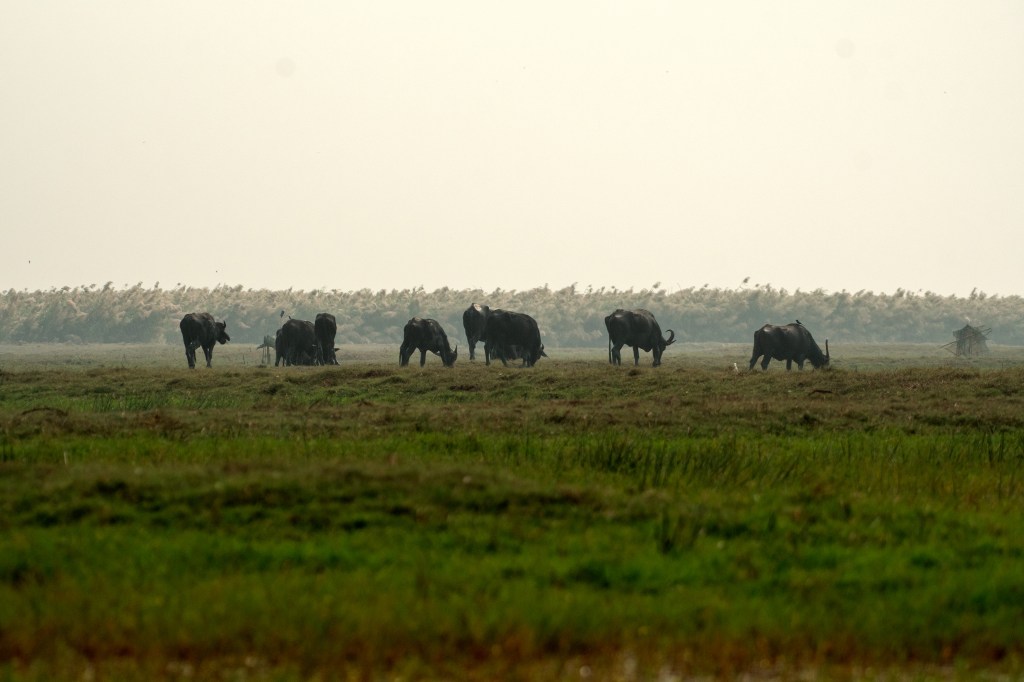
Between 3rd and 5th December of 2023, I visited this marshy wetland and stayed at Godwit Eco-Cottage which conducts ecotourism activities in Mangalajodi through Sri Sri Mahavir Pakshi Surakhsya Samiti. My first boat-ride in Mangajodi started at 10:30 AM with guide Ganesh. Each ride is typically for two and a half hours duration. Ganesh was particularly paranoid on that day by the local peasants. The 44 km2 marshy wetland of Mangalajodi is also a grazing ground of buffalos. That was the reason of annoyance as the gazing of cattle was shooing the birds away and causing harm to his ecotourism activity. As Mangalajodi has evolved from a poaching hell to birds’ heaven, the influx of world’s ecotourists and wildlife photographers, like any other ecotourism destinations, has set a different expectation from local nature guides. That was opportunities for getting “eye-level” shots of birds in action. These actions could be fighting of two birds, mating, hunting, feeding on prey or flying. The small country boat on shallow water of wetland, can take tourists and photographers very close to these birds without making much noise. Therefore, such expectation appears “reasonable” to this wetland’s human visitors.

This marshy land is also grazing ground for livestock

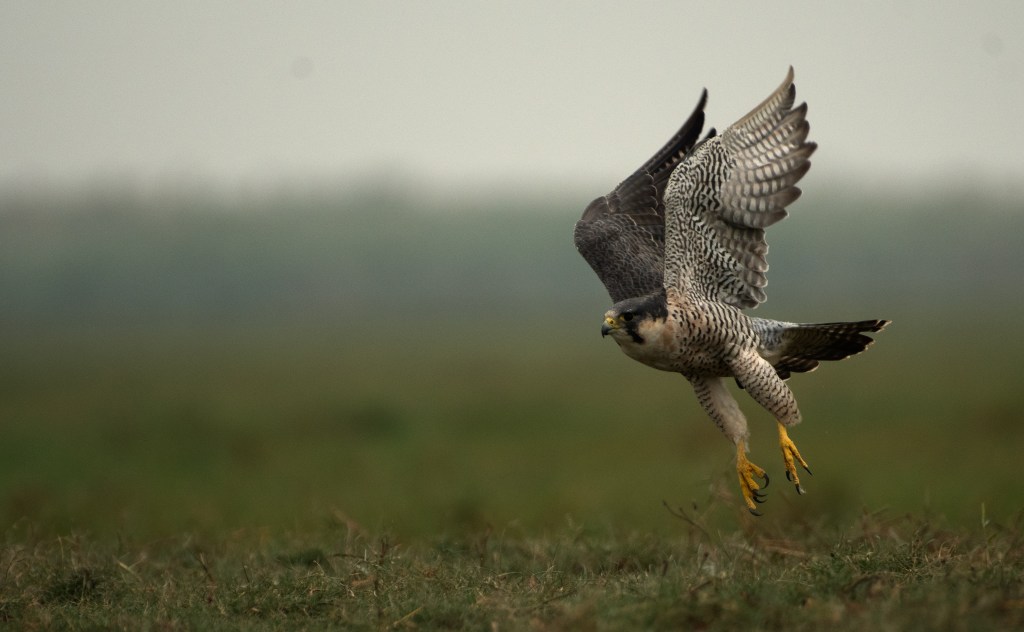
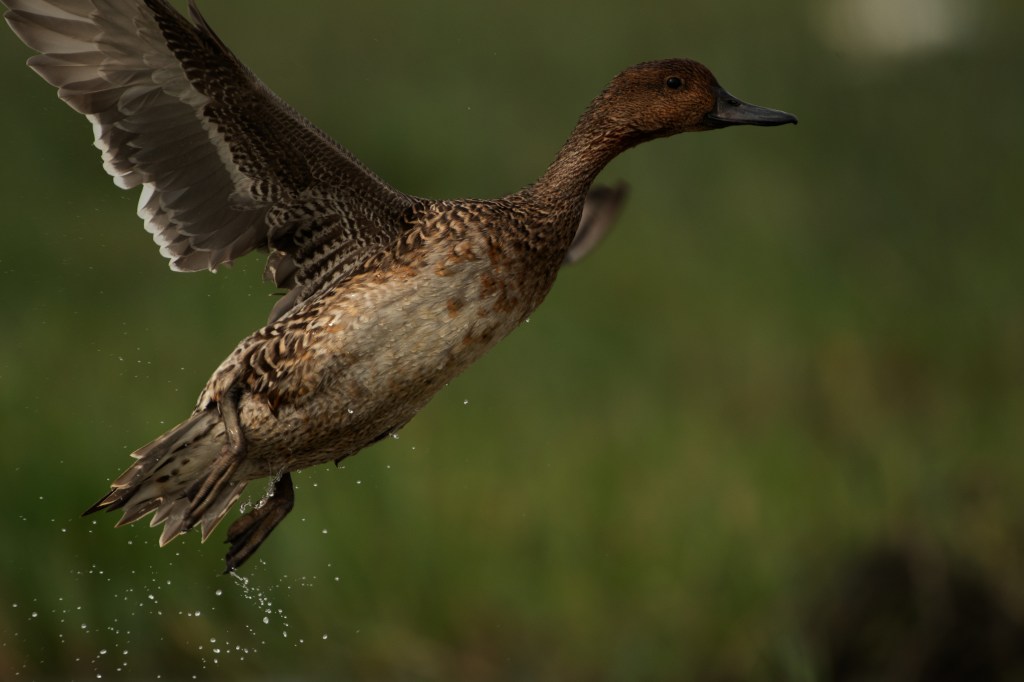
During my visit, in altogether four boat rides I saw 52 different species of migratory and resident birds including gadwall, spot billed duck, garganey, Northern pintail, Northern shoveler, ruddy shelduck, black-tailed godwit, black headed ibis, glossy ibis, Asian openbill stork, painted stork, Oriental pratincole, whiskered tern, marsh sandpiper, wood sandpiper, spotted redshank, little stilt, and few raptors such as peregrine falcon, Eastern marsh harrier etc. All two days were cloudy and gloomy with light shower, thanks to the suddenly developed cyclonic storm, in Bay of Bengal, called Michaung. Because of that the days were not so warm, which kept the birds less active. Despite such weather I could capture plenty of “action shots” by birds such as catching of snake by grey and purple heron, catching of fish by pond heron, catching of frog by ibis and plenty of flying shots by various waterfowl and raptors. Such is the enormity of Mangalajodi’ s photography and ecotourism potential.

Grey heron catching snake

A peregrine falcon taking off

Poacher turned conservationist Nanda Kishore’s wildlife photographer son Chinmaya rightly mentioned in his booklet on Mangalajodi, “This place is today one of India’s top wildlife tourism destinations having been placed firmly in the tourist circuit. The critical and catalytic role played by Wild Odisha, an organization for conservation of wildlife and nature, in a novel initiative of wearing away poaching and ensuring an alternative livelihood for them, has been documented as case studies. This initiative stands out today as one of India’s best practices in wildlife conservation.”

A Garganey taking off

Tourism which got initiated during 2002 by Wild Odisha with the support of the Chilika Development Authority, is today one of the chief bread earners for the families of the onetime poachers. From the Mangalajodi conservation and ecotourism model the world has understood that regulated, low-impact tourism has the potential to be a vital conservation tool as it helps win public support for wildlife conservation. During one of my four boat rides, another guide Anand told me that he was also a poacher. But now as nature guide, he may earn less than selling bird meat, but feels happier than before for not killing any innocent life.

A pair of migratory Northern pintail