

Mangalajodi Bird Sanctuary , part of Chilika Lake, A Ramsar site at India’s East Coast
To respond to various social, economic and environmental crises, today’s humankind seek compassion and loving-kindness through ecotourism. The most successful form of ecosystem services ecotourism, is wetland tourism. 2nd February each year is World Wetlands Day. It marks the date of the adoption of the Convention on Wetlands on 2nd February 1971, in the Iranian city of Ramsar on the shores of the Caspian Sea. World Wetlands Day was first celebrated in 1997. Since then, government agencies, non-governmental organizations and groups of citizens at all levels of the community have taken advantage of the opportunity to undertake actions aimed at raising public awareness of wetland values and benefits in general and the Ramsar Convention in particular. More than a decade ago in 2012, the World Wetlands Day theme was Wetlands and Tourism and was linked to the theme for the next meeting of the Conference of the Parties, COP11: Wetlands, Tourism and Recreation, which took place in June 2012, in Bucharest, Romania. In COP11, the benefits of wetland tourism both locally and nationally for people and wildlife were recognized – such as stronger economies, sustainable livelihoods, healthy people and thriving ecosystems. As per the World Wetland Day Reports 2012 from the contracting parties, “at least 35% of Ramsar Sites around the world record some level of tourism activity and this percentage is consistent throughout all regions. Of course, it is important to consider tourism in all wetlands – not just those designated as Ramsar Sites – since the Contracting Parties to the Convention are committed to managing all wetlands. Tourism is only one of the services that wetlands deliver. Ensuring well-managed tourism practices in and around wetlands and educating tourists on the value of wetlands contributes to the health of the world’s wetlands and the long-term benefits that wetlands provide to people, wildlife, economics, and biodiversity.”

Ecotourists row through this creeks in Mangalajodi for bird watching
The largest wintering ground for migratory birds on the Indian sub-continent, home to several threatened species of plants and animals is one such great example of wetland tourism. Chilika Lake is the largest brackish water lagoon in Asia and second largest coastal lagoon in the world, spread over the Puri, Khordha and Ganjam districts of Odisha state on the east coast of India, at the mouth of the Daya River, flowing into the Bay of Bengal, covering an area of over 1,100 square kilometres. The lake is an ecosystem with large fishery resources. It sustains more than 150,000 fisher–folk living in 132 villages on the shore and islands. The lagoon hosts over 160 species of birds in the peak migratory season. Birds from as far as the Caspian Sea, Lake Baikal, Aral Sea and other remote parts of Russia, Kirghiz steppes of Kazakhstan, Central and southeast Asia, Ladakh and Himalayas come here. These birds travel great distances; some of them possibly travel as much as 12,000 kilometers to reach Chilika Lake. In 1981, Chilika Lake was designated the first Indian wetland of international importance under the Ramsar Convention.
Mangalajodi is one of the many villages located in and around the Chilika Lake. The village is located about 5 km from Tangi in the district Khordha, 60 km from Bhubaneshwar and situated at Northern side of Chilika. It is a freshwater zone with marshes, reed beds and rich birdlife. What sets Mangalajodi apart is that every winter thousands of migratory waterfowl descends upon its marshes, transforming the area into a carnival as they jostle about with resident birds.
As per an article written by Aditya Panda, in Conservation India, titled as, Mangalajodi — A Village of Bird Protectors in Orissa, “up until the mid-90s, this winter carnival was often rudely interrupted by humans. As night fell on the noisy bird colonies, the sleepy villages surrounding the marsh would wake up. Dark shapes would lurk, gliding in canoes, crushing water-lily pods and lacing them with the deadly poison, Furatin. When dawn broke, hundreds of the birds would feast unknowingly on the deadly pods… canoe-loads of dead birds would thus be ready for meat markets far and near.”
Based on a booklet on Mangalojodi, written by Chinmaya Bhujabal, “poaching was causing irreparable damage to the avifauna of Managalajodi. There were about 80 poachers in the village, proficient in various techniques in killing birds. These birds are regularly sold in the open market, at rates varying from Rs. 20/- to Rs. 60/- per bird, depending on the species and method of killing. A proficient poacher can earn anything between Rs. 10,000/- to Rs. 40,000/- in a year. There was a huge damage to the wetland habitat due to rampant poaching of waterbirds.”
Another related article written by Himanshu Nitnaware in Thebetterindia.com, “the grim picture has transformed over the years, as poachers themselves have become conservators. Hard to believe? The figures prove that from a population of 5,000 birds in the early 1990s, the number has steadily increased to over 5,00,000 in 2021. This change has come around owing to the efforts of Nanda Kishore Bhujabal, who strived for years to work closely with villagers and help change their mindset. Earlier a poacher himself, Nanda realised his wrong ways during the early years of his life, and this made him bring about a change in others. At present, 25 such ex-poachers work towards bird conservation and as tourist guides for visitors.”

The ecotourism association in Mangalajodi, once they were poachers now they are protectors.
Chinmaya Bhujabal, who is none other than the son of Nanda Kishore, mentioned in the booklet on Mangalajodi, that in the winters of January 1996, Nanda Kishore along with some more persons, who later all came together to constitute an organization called “Wild Odisha”, had visited Managajodi village. That casual visit, to view migratory waterfowl, revealed a whole new world. Chinmaya mentioned, “It was late afternoon, and the whole place was resounding with gunfire. They saw many people moving around with guns and shooting, it was truly nightmarish!”
In 1999-2000, Nanda Kishore led the Wild Odisha team in Mangalajodi, could gain confidence of poachers/hunters for controlling poaching. During December of 2000. Sri Sri Mahavir Pakshi Surakhsya Samiti of Mangalajodi was born, consisting of poachers and hunters. Poaching was brought under control since then.
Between 3rd and 5th December of 2023, I visited this marshy wetland and stayed at Godwit Eco-Cottage which conducts ecotourism activities in Mangalajodi through Sri Sri Mahavir Pakshi Surakhsya Samiti. My first boat-ride in Mangajodi started at 10:30 AM with guide Ganesh. Each ride is typically for two and a half hours duration. Ganesh was particularly paranoid on that day by the local peasants. The 44 km2 marshy wetland of Mangalajodi is also a grazing ground of buffalos. That was the reason of annoyance as the gazing of cattle was shooing the birds away and causing harm to his ecotourism activity. As Mangalajodi has evolved from a poaching hell to birds’ heaven, the influx of world’s ecotourists and wildlife photographers, like any other ecotourism destinations, has set a different expectation from local nature guides. That was opportunities for getting “eye-level” shots of birds in action. These actions could be fighting of two birds, mating, hunting, feeding on prey or flying. The small country boat on shallow water of wetland, can take tourists and photographers very close to these birds without making much noise. Therefore, such expectation appears “reasonable” to this wetland’s human visitors.
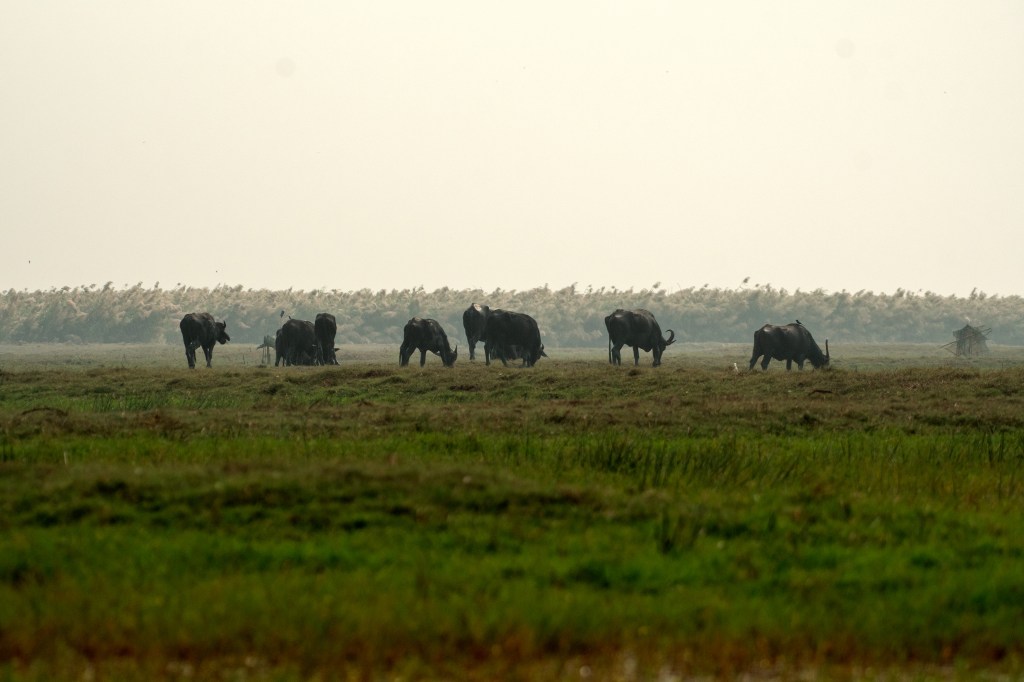
This marshy land is also grazing ground for livestock
During my visit, in altogether four boat rides I saw 52 different species of migratory and resident birds including gadwall, spot billed duck, garganey, Northern pintail, Northern shoveler, ruddy shelduck, black-tailed godwit, black headed ibis, glossy ibis, Asian openbill stork, painted stork, Oriental pratincole, whiskered tern, marsh sandpiper, wood sandpiper, spotted redshank, little stilt, and few raptors such as peregrine falcon, Eastern marsh harrier etc. All two days were cloudy and gloomy with light shower, thanks to the suddenly developed cyclonic storm, in Bay of Bengal, called Michaung. Because of that the days were not so warm, which kept the birds less active. Despite such weather I could capture plenty of “action shots” by birds such as catching of snake by grey and purple heron, catching of fish by pond heron, catching of frog by ibis and plenty of flying shots by various waterfowl and raptors. Such is the enormity of Mangalajodi’ s photography and ecotourism potential.

Grey heron catching snake
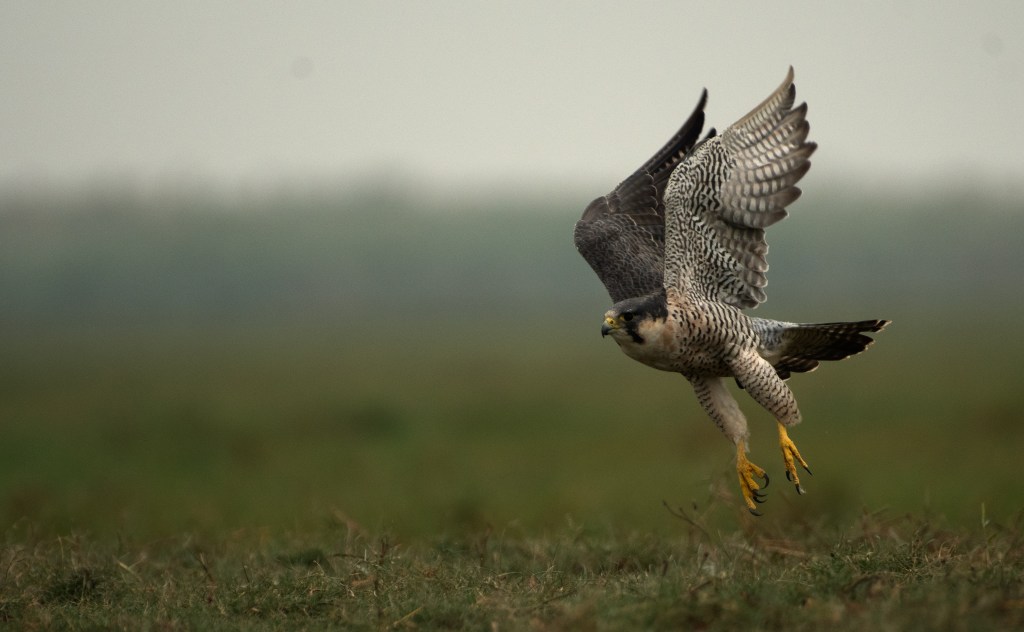
A peregrine falcon taking off
Poacher turned conservationist Nanda Kishore’s wildlife photographer son Chinmaya rightly mentioned in his booklet on Mangalajodi, “This place is today one of India’s top wildlife tourism destinations having been placed firmly in the tourist circuit. The critical and catalytic role played by Wild Odisha, an organization for conservation of wildlife and nature, in a novel initiative of wearing away poaching and ensuring an alternative livelihood for them, has been documented as case studies. This initiative stands out today as one of India’s best practices in wildlife conservation.”
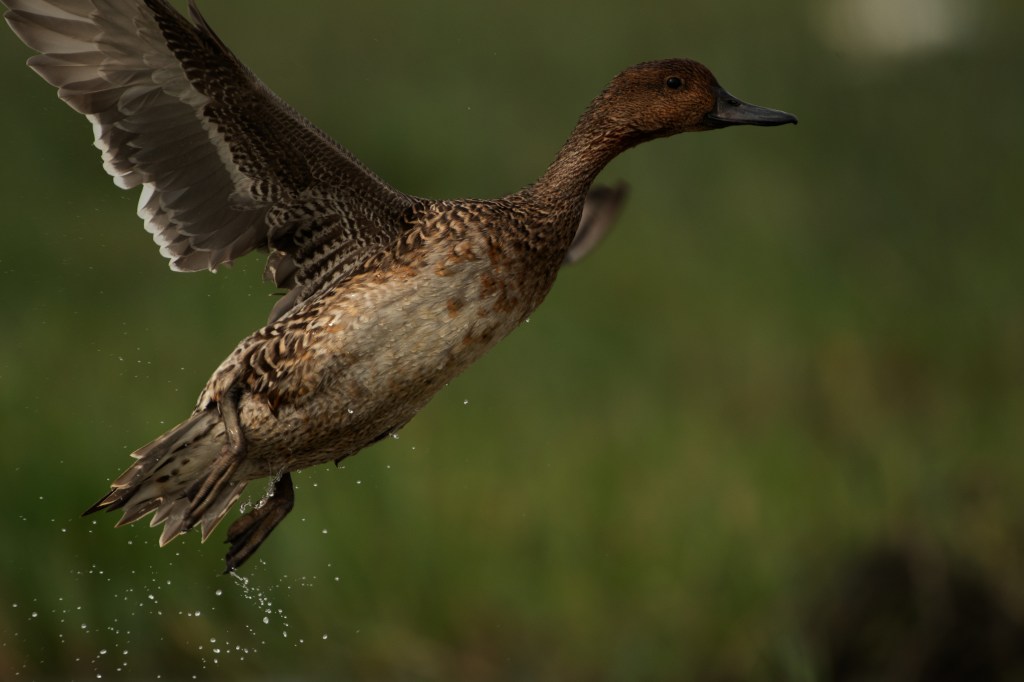
A Garganey taking off
Tourism which got initiated during 2002 by Wild Odisha with the support of the Chilika Development Authority, is today one of the chief bread earners for the families of the onetime poachers. From the Mangalajodi conservation and ecotourism model the world has understood that regulated, low-impact tourism has the potential to be a vital conservation tool as it helps win public support for wildlife conservation. During one of my four boat rides, another guide Anand told me that he was also a poacher. But now as nature guide, he may earn less than selling bird meat, but feels happier than before for not killing any innocent life.

A pair of migratory Northern pintail
 Pseudo Ecotourism