In the Shadow of the Bengal Tiger: How it was started….

To cope with rejection in personal life, I find various ways to become the most interesting guy in the room. Later, when I meet one of my childhood friends, Vedavyasa, who is on his own quest for fame and glory, I was introduced to ecotourism and wildlife photography through my fist ever wildlife safari in the arid forest of Gir. In my new-found hobby, the underlying cause for human obsession with fame and glory does not go unnoticed. This underlying cause is created by the materialism of today’s world as a new commodity for fame hungry people.

Mane Lodge at Gir

Gir National Park and Wildlife Sanctuary, also known as Sasan Gir, is a forest, national park, and wildlife sanctuary near Talala Gir in Gujarat, India. It is located 43 km (27 mi) north-east of Somnath, 65 km (40 mi) south-east of Junagadh and 60 km (37 mi) south-west of Amreli. It was established in 1965 in the erstwhile Nawab of Junagarh‘s private hunting area, with a total area of 1,410.30 km2 (544.52 sq mi), of which 258.71 km2 (99.89 sq mi) is fully protected as a national park and 1,151.59 km2 (444.63 sq mi) as wildlife sanctuary. It is part of the Khathiar-Gir dry deciduous forests ecoregion.

The 14th Asiatic Lion Census 2015 was conducted in May 2015. In 2015, the population was 523 (27% up compared to previous census in 2010). The population was 411 in 2010 and 359 in 2005. The lion population in Junagadh District was 268 individuals, 44 in Gir Somnath District, 174 in Amreli District, and 37 in Bhavangar District. There are 109 males, 201 females and 213 cubs.

The population of Asiatic lions has steadily grown in Gir forest, and the broader Saurashtra protected area. The lion population escalated from 523 to 674 individuals between the years 2015 and 2020.

Gir National Park is closed from 16 June to 15 October every year, throughout the monsoon season.

Source: Wikipedia

Pugmark of an Asiatic Lion
First sighting of Asiatic Lion (female) at Gir
Male India pea fowl at Gir

The exploration to spot Asiatic Lion started at 6:00 am of 25th May 2015 through route number 6 of Gir National Park.  Forest guide Abu bhai and driver Mehbub accompanied my friend and me. Immediately after entering the forest, fresh pugmarks were observed. As usual we started following the footprints – movement of male and female with cubs were quite prominent among other pugmarks. The trail was suggesting a small pride was probably shifting from one location to another. Strong smell of carcass was also felt, but no vultures or other scavengers were found anywhere around. After two hours of tracking and covering around 20-25 Km distance, finally two sub-adult males were spotted from around 60-meter distance under shades of trees at the crossing point of safari route number 5 and 6 of the park. They were found lying under the shades of trees. Few forest guards were found to be gathered there. This is typical scenario in Gir. Wherever lions are sighted there would be few forest guards sitting leisurely at a safe distance with stick in their hands. Photographers take images of those lions, and there would be a suggestive body language of ownership displayed by those guards, as if their pets were being photographed. “Cohabitation” indeed. These guards informed us that, early in the morning both the lions hunted together and after eating they had started moving to find a cool place to take rest for the whole day.

To know what happened in my very first wildlife photography trip in Gir National Park and how my life started changing after that trip, read my recently published book.

Its available in paperback, hardcopy and eBook at:

https://www.ukiyotoindia.com/product-page/pseudo-ecotourism

For International readers at:

https://www.ukiyoto.com/product-page/pseudo-ecotourism

It’s also available in Amazon:

Hardbound, Dust Jacket, Kindle and Paperback

The unexplored ecological wonder of North-East Hill landscape: Maguri Beel

Maguri Motapung Beel is a wetland and lake located near Dibru-Saikhowa National Park and Motapung Village of Tinsukhia district in Assam. Maguri Motapung Beel serves as a natural home to wildlife and provide a source of livelihood to the local communities.

On May 27, 2020, a fountain of crude oil polluted the waters of the wetland, and it caught fire on June 9. Conditions have recovered since then, and one highlight for the Maguri Beel wetland post the disaster has been the sighting of a Mandarin Duck in the lake for the first time in 118 years.

Maguri beel in dense fog of winter morning

On 17th December, at around 5:00 PM we reached at Maguri beel. Our nature guide Palash has his own resort there. He also lives in a nearby village. After reaching there Palash took us to couple of nearby tea estates to search for brown hawk owl, oriental and collared scops owl. Eventually in the village itself we found hawk owl and in the front yard of Palash’s house we found quite a few collard-scops owl perching on trees.

Collard scops Owl

Next day as early as 5:30 in morning after a short boat ride we reached at the other side of the Maguri beel to explore the grassland which is also part of Dibru-Saikhowa National Park. There we spotted hen harrier, endangered swamp grass babbler, golden cisticola and straited babbler. Then at around 7:00 AM we went to another side of the grassland across the water body near the Baghjan village. The village is also known as the victim of one of the recent environmental disasters. A blowout, explosion, and fire lasting more than five months, from 27th May to 15th November 2020 the natural gas well of Oil India Limited (OIL) at Baghjan in Assam’s Tinsukia district has resulted in the loss of an estimated 55 % of the biodiversity in the affected Dibru-Saikhowa landscape. As many as 1,632 hectares of wetland, 523 ha of grassland, 172 ha of area covering rivers and streams, and 213 ha of forest were damaged to varying degrees.

Swamp grass babbler

During our exploration in the grassland of Baghjan, we spotted the vulnerable and elusive marsh babbler. Besides that, we also spotted dusky babbler, chestnut capped babbler and puffed chested babbler among other regular birds.

Marsh babbler

In this whole trip of Dehing, Namdapha and Maguri Beel-Dibru-Saikhowa, I saw around 100 different birds and 80% of them were spotted for the first time ever in my life. That was why it was one of my memorable biodiversity and photography trips in India. Forests of Arunachal, indeed, have much more to offer than tigers and elephants. However, the Forest Department of this country was always sounded hopeless about the forests of Arunachal Pradesh for not sighting of tigers and elephants.

Swampland between Maguri beel and Dibru-Saikhowa

Based on an article written by Rupak Goswami in 1st August 2023 edition of EastMojo, “At Namdapha Tiger Reserve (NTR) in Arunachal Pradesh, none of the Range Officers stays inside the NTR area, and the responsibility of on-the-ground protection is largely delegated to the contingency staff, who are about 150 in number, out of which 50 are part of the tiger protection force. This sensitive landscape of 1985km2 with unique biodiversity, is managed by three ranges with a very meagre staff. The infrastructure for protection, like roads, patrolling paths, anti-poaching camps and motorcycles is very poor. The tiger reserve is hit hard by encroachment issues due to the increasing populations of the Lisus and other tribes. The Lisus are expanding their areas under cultivation and cardamom has a ready market as a cash crop. As of now, it is reported that there are eight Lisu villages with 311 families occupying the critical tiger habitat.”

As per this article, the presence of elephants of late has not been reported from within NTR. We know only one tiger was reported in 2022 NTCA tiger status report. The Management Effectiveness Evaluation Report (MEE) of the Namdapha Tiger Reserve said, “it is apprehended that probably the elephant population has adversely been impacted by hunting by tribes which might have found a ready market in the neighbouring countries”.

A section of Maguri Beel sand bed

Although I said before that, forests of Arunachal have much more to offer than tigers and elephants, but one cannot deny that to protect this exquisite biodiversity, tigers and elephants are required too. Otherwise, human greed will eventually perish the biodiversity abundance of the “Land of the Rising Sun”.


The unexplored ecological wonder of North-East Hill landscape : Namdapha

Based on 2022 NTCA tiger status report of India, tigers were photo-captured for the first time in Buxa Tiger Reserve, Neora Valley National Park, and Mahananda Wildlife Sanctuary in West Bengal. Also, after quite a few years, a tiger was photo-captured in the Namdapha Tiger Reserve of Arunachal Pradesh. The report also mentions that Tiger reserves and protected areas in Arunachal Pradesh are connected through large, forested tracts and a number of reserve forests situated along the interstate border between Arunachal Pradesh and Assam.

This landscape is further connected to Intanki National Park in Nagaland and Dampa Tiger Reserves in Mizoram through some weak linkages of degraded forest. Several indigenous forest communities dependent on bush meat and forest resources for subsistence inhabit this landscape; hence, the prey base is almost depleted in many of the forests. In addition, due to its strategic location, several highways are planned in Arunachal Pradesh to provide faster access to international border areas.

Entry of Namdapha

Arunachal Pradesh gets three national highways: the Frontier Highway, the Trans-Arunachal Highway, and the East-West Industrial Corridor Highway, and six vertical and diagonal interstate highways of about 2178 km will be built. Fragmentation of habitat by this rapid infrastructure development will eventually destroy the weak linkages between the tiger habitats and might lead to the local extinction of tigers in this landscape. Substantial poaching for the illegal trade of tiger body parts and ungulates constantly threatens the tiger population in this landscape. Since the landscape shares porous international borders in many parts with neighbouring Southeast Asian countries, it is comparatively easy for poachers to operate in this landscape. In the recent past, the skin and body parts of two tigers were seized from Dibang Valley in Arunachal Pradesh and Itakhola on the Assam-Arunachal Pradesh border. Direct exploitation of tigers from this already low abundant population, coupled with habitat fragmentation and biotic pressure, could eventually deplete the tiger population in this landscape. Other than rapid development causing habitat fragmentation and the poaching of wild tigers and prey, the invasion of weeds in the natural habitat is a severe threat to this landscape.

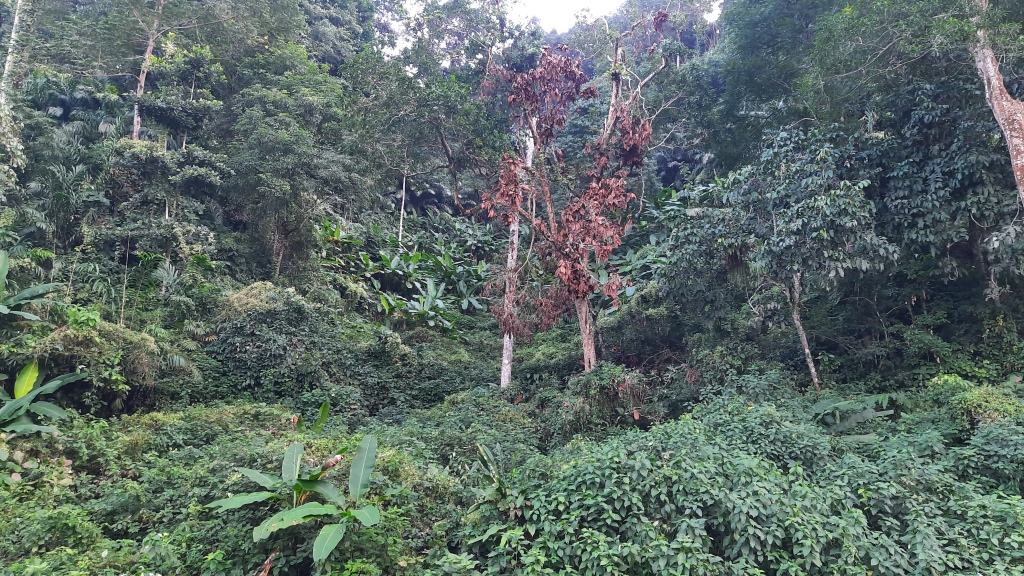
Forest of Namdapha

The institute responsible for tiger conservation in India itself recognizes these facts behind depleting tiger population in the Dibang-Kamlang-Namdapha block of tiger landscape in Arunachal Pradesh. The state has three tiger reserves namely Pakke, Kamlang, Namdapha tiger reserve and Dibang Wildlife Sanctuary. As per 2022 tiger status survey, only nine tigers were photo-captured in this state.

However, the status of Arunachal’s tiger population does not tell the real story of its phenomenal biodiversity resources. This state is an ecological wonder that remains largely unexplored. The tropical rain forest of the Namdapha National Park, one of India’s largest protected area, throbs with a dizzying array of flora and fauna, many of which are lesser known, hidden gems of the wild.

Devan camp of Namdapha

After completing our exploration in Dehing, on following day, on 14th December, at around 6:00 AM we started for Namdapha National Park and Tiger reserve, the main destination of our exploration. On the way we stopped at various village forests, ponds and water streams for bird watching. Some noteworthy sightings were – greater necklace laughingthrush and red headed trogon near exit gate of Dehing; Oriental pied hornbill feeding on banana and coconut tree in a village; pied falconet perching on a tree top and occasionally snooping for butterflies, just before the entry gate of Namdapha; and few black capped and white crowned forktails near a water stream within Namdapha. We reached at Devan Forest camp of Namdapha at around 4:00 PM. In this part of India, sun goes down by 4:00 PM and by 4:30 PM light was quite low. In the evening between 6:00 PM and 8:30 PM we did a nigh-walk within the tiger reserve to search for slow loris. We stayed in Devan camp for three nights and every night we searched for that nocturnal animal. But never succeed. Instead, every night we saw red giant flying squirrel feeding on tree bark within our campus.

Pied falconet

On 15th December at morning 6 o’clock we did a moderate hiking in the Haldi Bari area of the tiger reserve. From our forest camp it was three hours hike, which included crossing Nua Dehing river through a precariously constructed bamboo hanging bridge, climbing steep hillock, and walking through dense foliage. From the hoolock gibbon, the only ape species found in India, to the elusive snow Leopard and the majestic red panda, Namdapha is a living testament to the intricacies and wonders of evolution. The day was sunny, and the forest was resounded with iconic call of hoolock gibbons. This reserve is unique, not just for its lofty stature as the third largest of its kind in India but also due to the strikingly varied altitudinal range of its landscape. Ranging from 200 metres to an astounding 4,500 metres, it provides the tiger and numerous other species with an environment of unparalleled diversity.

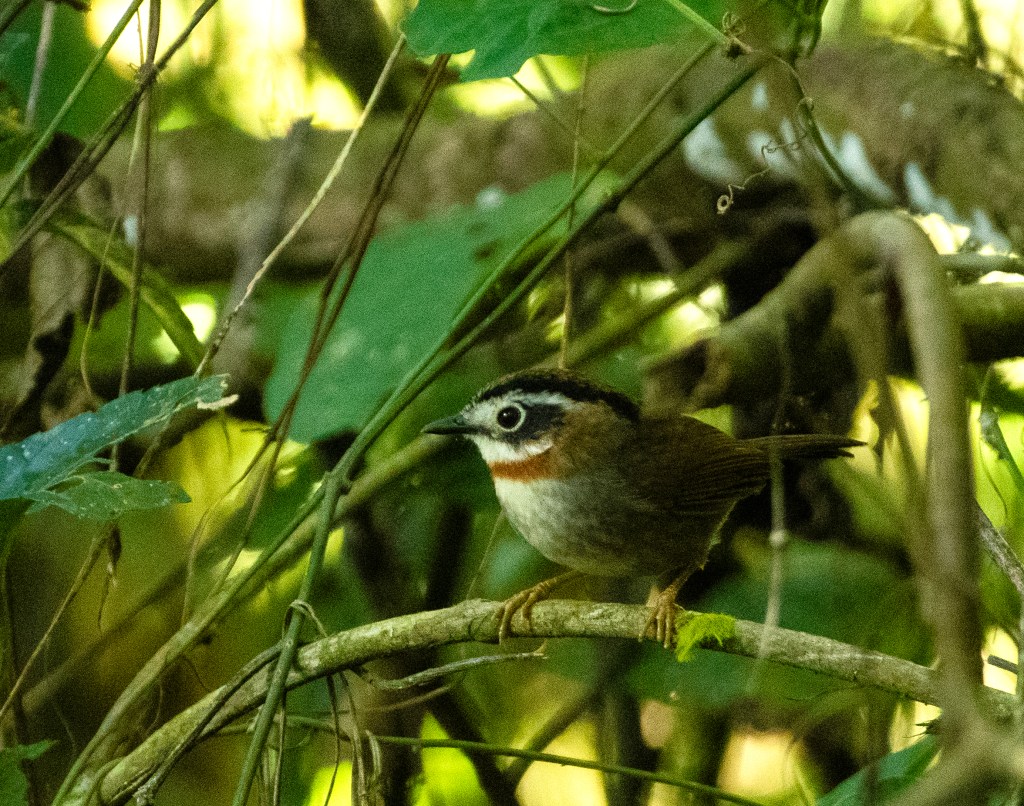
Eye-browed wren babbler

Before we returned to our camp at 12:00 noon, quite a few rare birds we spotted and shot. Some of them were slaty bellied tesia, white tailed flycatcher, streaked wren-babbler, white throated bulbul, rufus backed sibia, long-tailed broadbill, Durian redstart, and eye-browed wren-babbler. Afternoon again we explored the road goes through buffer zone of Namdapha towards Vijaya Nagar, where India ends, and Myanmar starts. Oriental hobby, rufous-gorgeted flycatcher, dark breasted rose finch, little forktail were some notable sightings. Our day ended with much delight by sighting of Oriental Bay owl, which we were trying to spot from day one.

Oriental bay owl

Next day was all about full day walk on the road passing through tiger reserve towards India-Myanmar international border. We left our camp at 6:00 AM and returned at 5:00 PM. Between Deban camp and Kamala Valley camp we spotted and identified birds like white-bellied erpornis, snowy throated wren babbler, brown crowned scimitar babbler, greater rufous headed parrot bill, white hooded babbler, hill prinia, black throated sunbird, white-rumped munia, Nepal fulvetta, pale-billed parrot bill, white browed piculet, whistling warbler, grey headed canary flycatcher, black chinned yuhina, long-tailed sibia, and mountain imperial pigeon.

pale-billed parrot bill

As per Forest Department’s norm, one local forest guide named Assam Mussang was also with us for two days in Namdapha. He told us that tourists are allowed only in selected routes in buffer zone of this tiger reserve. Rest of the forest is not even suitable for walking. Leave aside the possibility of driving car or jeep. Therefore, ecotourism activity does not happen in most of the buffer and entire core zone of Namdapha. Only forest department staffs and researchers go there for study and installing camera traps. Even forest patrolling is limited in majority part of this forest due to difficult accessibility. That is why probably NTCA was also sounded helpless in their 2022 tiger status report while explaining depleting tiger and its prey base population in Arunachal Pradesh. Assam Mussang told us that Kodwai zone is part of buffer and core, where maximum number of tiger pugmarks and camera trap images were recorded. His comment was well resonated with NTCA’s 2022 status report of recording one tiger in Namdapha.

Red giant squirrel

The day was sunny and the snow-capped Dapha bum, the highest point of Namdapha was visible from our exploration track. Despite of depleting tiger population, Namdapha stood tall with array of its magnificent biodiversity. As one steps into an era marked by climate change and biodiversity loss, Namdapha shines as a beacon of hope, a sanctuary where life thrives in its countless forms. It stands as a testament to the resilience of nature when given the chance to flourish and the power of people when they become stewards of the land. At the end of the day when we came back to our camp, the resident red giant flying squirrel was found to be feeding on tree bark. That was how my last night in India’s last tiger reserve ended with a message, “to become a splendid ecotourism destination, raining of tiger sighting is not essential. The forest has much more to offer than the tigers.”

Snow-capped Dapha boom

We left Namdapha on 17th December, towards Miao, the border town between Arunachal and Assam. Our next destination on Maguri bill which was in news because of one of the recent environmental disasters of India.

The unexplored ecological wonder of North-East Hill landscape – Dehing Patkai

North-East landscape of India comprises the states of Arunachal Pradesh, Assam, Manipur, Mizoram, Nagaland, Sikkim, Tripura, and hilly districts of northern West Bengal. This landscape can be further classified as North Bengal Dooars, Brahmaputra flood plains, and North-East hill region. It is situated alongside international borders with Nepal, Bhutan, People’s Republic of China (China occupied Tibet), Myanmar, and Bangladesh, and connected to peninsular India through a narrow strategic stretch, Siliguri Corridor. As the landscape shares 90% of its boundary with neighbouring countries, it is one of the most important geo-strategic locations of the country. This landscape also is home to more than 200 ethnic and indigenous communities. Other than the cultural plurality, North-East and Brahmaputra flood plains landscape is diverse with natural resources.

Since the landscape shares porous international borders in many parts with neighbouring Southeast Asian countries, it is comparatively easy for poachers to operate in this landscape. In the recent past, the skin and body parts of two tigers were seized from Dibang Valley in Arunachal Pradesh and Itakhola on the Assam-Arunachal Pradesh border. Direct exploitation of tigers from this already low abundant population, coupled with habitat fragmentation and biotic pressure, could eventually deplete the tiger population in this landscape. Other than rapid development causing habitat fragmentation and the poaching of wild tigers and prey, the invasion of weeds in the natural habitat is a severe threat to this landscape.

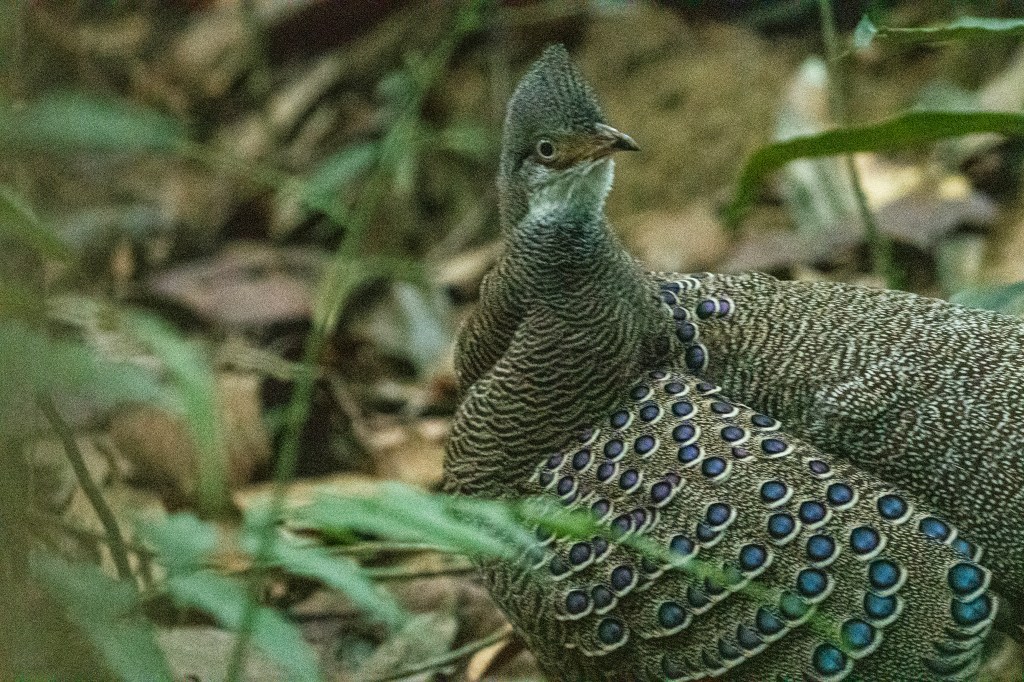
Grey peacock pheasant at Dehing Patkai

Between 12th and 18th November of 2023, I did intense biodiversity exploration in around 400 km stretch consisting of Diban camp of Namdapha and its surrounding areas including Haldibari, Highiand and Kamala Valley camp, Dheing Patkai National Park and Maguri beel as well as adjacent grasslands of Dibru Saikhowa National Park. Around 2:30 PM, we started our journey from Dibrugarh airport and reached at our homestay in Digboi at 6:00 PM. I was with a reputed bird watching guide of North-East, named Palash Phukan. I was also joined by another experienced bird photographer from Pune, named Suyog Ghodke.

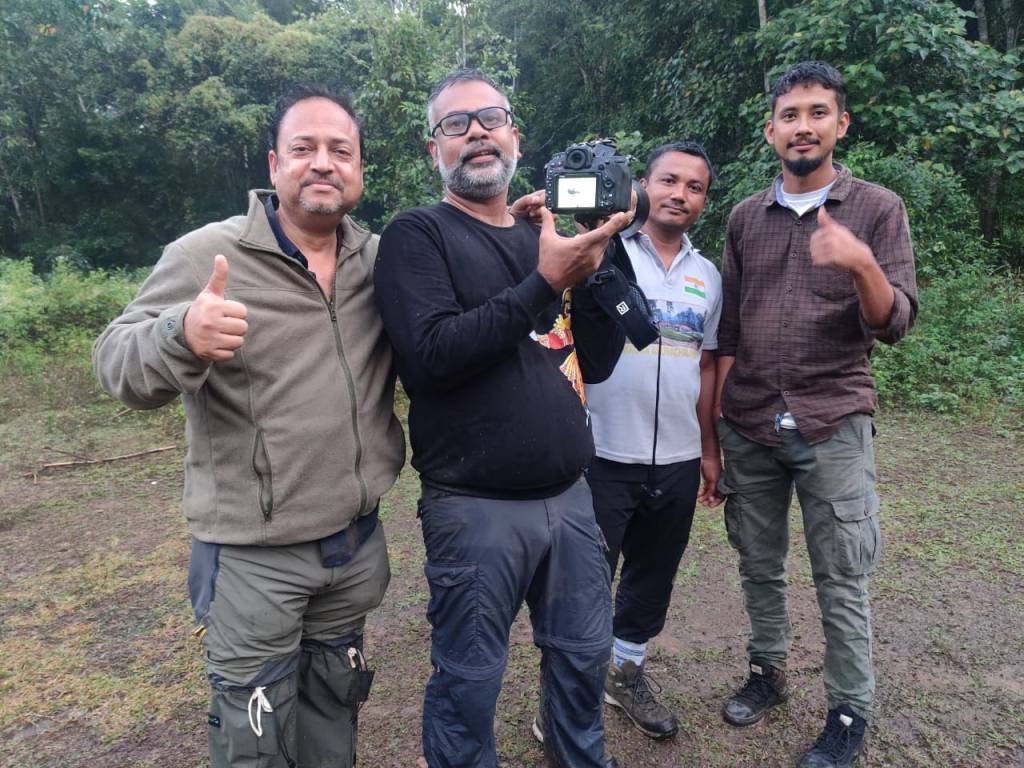
Dehing Patkai exploration team

As per schedule, after reaching close to our homestay in Digboi, we went to look for Oriental Bay owl in the forest of Dehing. Dehing Patkai National Park harbours the largest stretch of lowland rainforests in India. The rainforest stretches for more than 575 km2 in the districts of Dibrugarh, Tinsukia and Charaideo. The forest further spreads over in the Tirap and Changlang districts of Arunachal Pradesh. The Wildlife Sanctuary was also declared as Dehing Patkai Elephant Reserve under Project Elephant. After reaching at a particular patch of dense forest, which was apparently not allowed to be explored on foot, Palsh started playing call of bay owl. Within few seconds the bird started responding to that call from a nearby tree. However, before spotting the bird, Palsh’s torch light caressed through an elephant like object. In the darkness it was not possible to distinguish that object clearly from the large tree trunks in background. Nevertheless, an elephant head like curvature was vaguely noticed in torchlight.

That unclear vision mixed with fear and imagination was enough to make all of us run for our dear life and get inside the car parked around 100-200 meters away from the forest patch. Elephant is the main reason why exploring Dehing’s forest in foot in darkness is not allowed.

Ashy headed green pigeon at Dehing

Next day, we started at 6:00 AM and continued till lunch break at 1:30 PM. It was all bush walking, ascending, and descending through dense foliage of Dehing Patkai rainforest. Within an hour of our morning exploration, we got to see a male grey peacock pheasant. When we were busy in shooting that bird from quite proximity, our driver Guru sent an SOS of elephant alert through walkie-talkie to Palash. He saw a male elephant standing behind our car which was parked on the forest path and upon noticing Guru it entered deep forest, where we were busy with peacock-pheasant. Therefore, another run for the life for us and that was bit difficult and far scarier than the previous one. That time the sighting of elephant was real and forest path was more hostile because of thorny bush, thick foliage, and muddy path.

Rufus throated fulvetta at Dehing

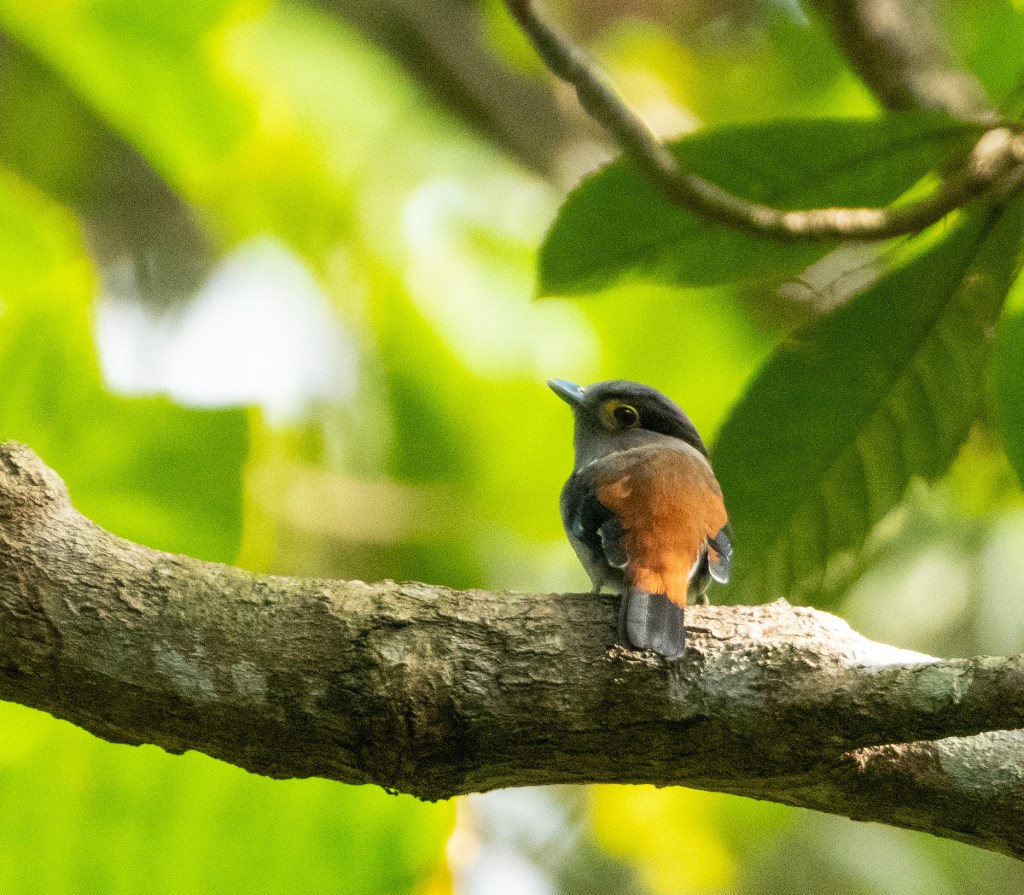
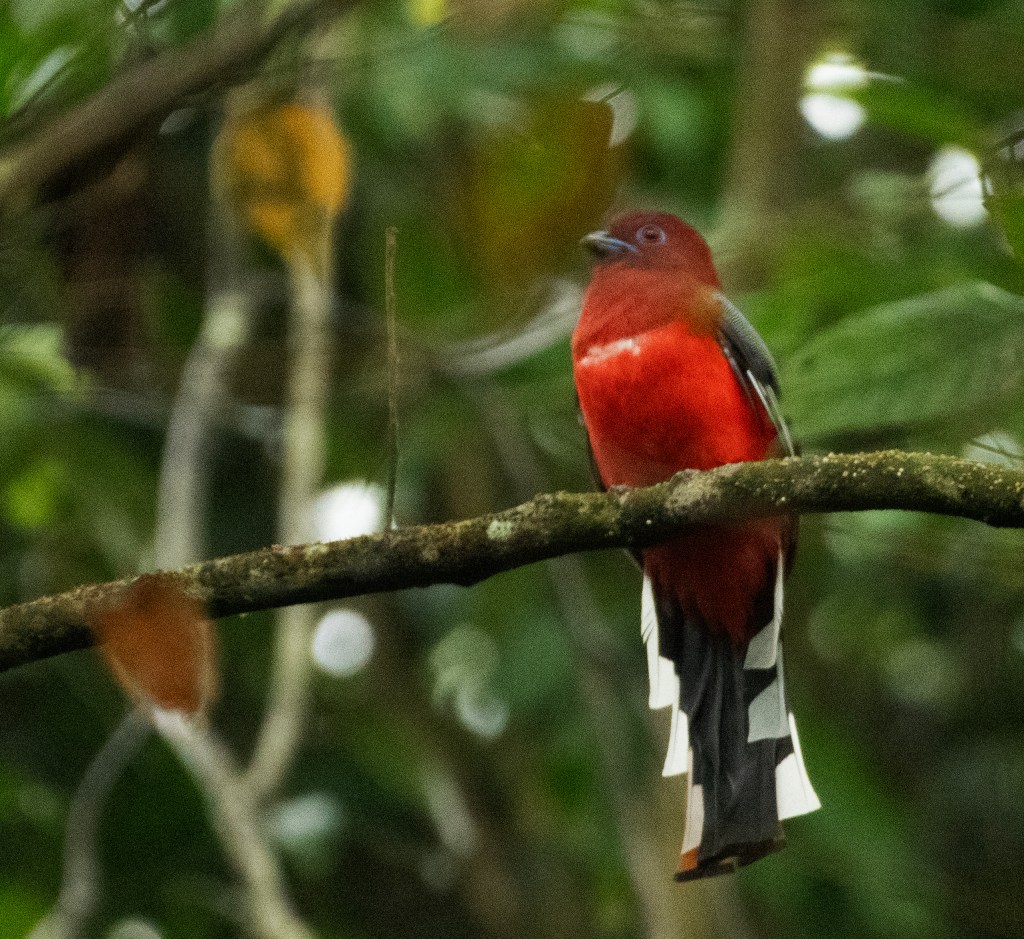
Somehow, we came out of dense forest and reached where our car was parked. It was time for breakfast after few hours of intense bird-walk. Rest of the morning we did easy to moderate hike in the forest and spotted various birds which were first in life sighting for me, such as grey peacock-pheasant, pale capped pigeon, rufus throated fulvetta, chestnut backed laughing thrush, silver breasted broadbill, ashy headed green pigeon, blue-winged leaf bird, red headed trogon, and white spectacled warbler.

Grey-lored broadbill at Dehing

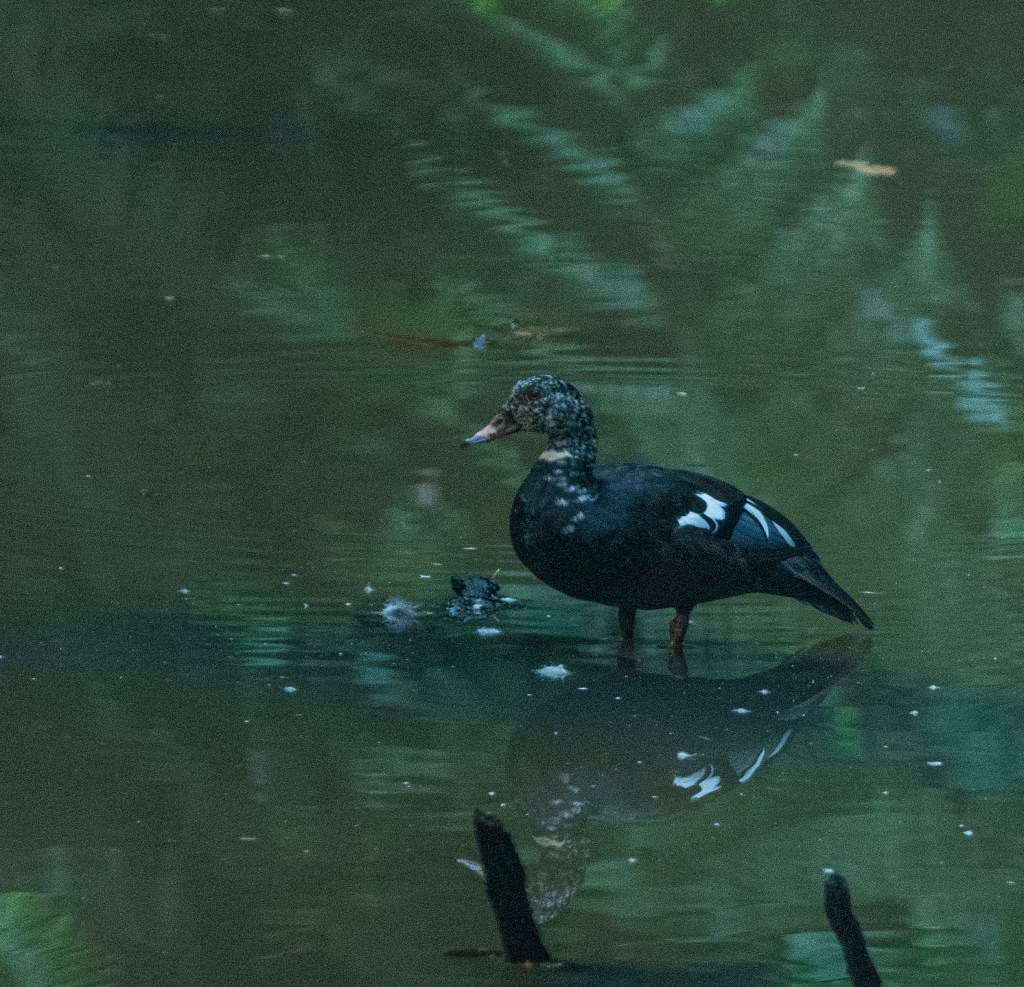
The most exciting exploration in Dehing happened on that afternoon. After a sudden heavy shower, the forest path was muddy and slippery. Therefore, ascending and descending on steep slope became quite difficult. After couple of hours’ physical effort, surviving fear of fall risks, and few actual falls on forest path we reached near a pond and were delighted by a sighting which we would like to cherish for ever. It was a male white-winged wood duck, the state bird of Assam. Decaled as Endangered by IUCN, historically, the white-winged duck was widely distributed from North-Eastern India and Bangladesh, throughout South-East Asia to Java and Sumatra. It is now extinct in Java. In India, the duck is found only in the North-Eastern part of the country, with the main concentration in Eastern Assam and adjacent areas of Arunachal Pradesh. However, in 2002 it had a population of only 800, with about 200 in Laos, Thailand, Vietnam, and Cambodia, 150 on Sumatra, notably in Way Kambas National Park and 450 in India, Bangladesh, and Myanmar. Due to ongoing habitat loss, a small population size, and because this duck is hunted for food, eggs and pets, the white-winged duck is evaluated as Endangered on the IUCN Red List of Threatened Species. In India, the key protected areas for the white-winged duck are Dibru-Saikhowa National Park, Dehing-Patkai Wildlife Sanctuary, Nameri National Park and Namdapha National Park. The white-winged duck occurs in dense tropical evergreen forests, near rivers and swamps.

The elusive white winged wood duck at Dehing – state bird of Assam

Dehing-Patkai as a potential wildlife sanctuary was identified in late 1980s during a primate survey as “Upper Dehing Wildlife Sanctuary”. Subsequently during a study on white-winged wood duck in early 1990s, it was discovered as a globally important site for this duck and recommended to be upgraded to “Upper Dehing National Park”.

After white-winged wood duck sighting for nearly two hours we again went for bay owl when it was dark. But fear of elephant in mind did not let Palash and us to focus on that bird. Therefore, we called it a day and returned to our homestay.

A male red headed trogon at the exit gate of Dehing Patkai National Park

Our next destination was Namdapha Tiger Reserve of Arunachal Pradesh!